Wednesday, 23 March 2016

Come and Work with Us on Moral and Legal Responsibility and Agency!


The practical philosophy group at my department has for many years been working on building a research environment focusing broadly on responsibility as a topical theme. This theme encompasses all aspects of moral and legal responsibility and agency, and ranges from the applied and practice oriented (related to different areas and institutions), to the most general and fundamental issues in philosophy, moral and legal theory. It also contains openings for cross-disciplinary collaborations, e.g., with psychology, psychiatry, neuroscience, law, politics and economics. Last year, thanks to a major 10-year grant from the Swedish Research Council, we could welcome Paul Russell as new professor within this theme, who now leads the resulting Gothenburg Responsibility Project (GRP), and also a first round of post docs.

Now the GRP is opening its second call for post docs, and we are, of course, very keen on having applications from people in the postdoctoral phase of their careers, who feel that their field of research fits the GRP theme, and that spending a few years at our department is an attractive prospect. If that's you, please go here for more practical details!

Sunday, 6 March 2016

Personalised, Individualised or Precision Medicine: Three Unaddressed Socio-economic Hurdles


After the BRAIN initiative of 2013, in 2015 US president Obama announced another large scale government funding scheme for biomedical science, on so-called Precision Medicine. Just recently this initiative announced its first pilot study. Leaving the unfortunate terminological analogue of "precision bombing" (eventually known precisely for its lack of precision) to a side, precision medicine is basically nothing new compared to what's already been known among medical scientists as individualised or personalised medicine, except that the Obama initiative has added large scale so-called Big Data methodology to the mix. The vision (described in these reports by the European Science Foundation in 2012) is that of a new strategy in pharmacological treatment consisting of two broad dimensions:

  • Individually designed choice and style of medication (types of drug, dosage scheme, etc), based on complex analyses of pretests of genetic and other factors of relevance.
  • Vastly increased use of presymptomatic screening of people to pick up possible early fragilities disposing for or signs of illness, to then attack with the mentioned new treatment strategies in early stages.
I'll call these dimensions treatment and screening respectively below. Both offer tremendous scientific challenges, still mostly to be overcome. But in this post I'll be assuming that the science has been worked out and instead point to three seemingly rather difficult socio-economic hurdles for the personalised, individualised or precision medicine ultimate agenda to ever be realised. For, naturally, the endpoint is not about the science as such, but to take significant additional steps in bettering human health and the fighting of disease. For that to occur, the existence of scientifically demonstrated natural mechanisms and technological solutions is far from enough. There also has to be a realistic socio-economic production and delivery system with a potential to make the mechanisms and technologies further the ultimate aim.

Hurdle 1: Practical inconsistency and the societal costs of screening
The first hurdle becomes visible when appreciating that the two dimensions are bound to partly work against each other. This as the screening dimension, due to elementary features of statistics and scientific measurement, will most probably mean increased imprecision; the more potential signs of conditions that are picked up in more people, the more likely it will be that signals for possible disease are what is known as false positives, and the more likely it will be that any signal is untrue due to weak predictive value. This, in turn, is especially likely the more the screening dimension addresses conditions as these will be defined in the treatment dimension: these condition will then be increasingly rare (due to the increased precision and individualisation in characterising them), a factor well-known to decrease the precision of screening programmes. This, in turn, will mean that the screening dimension is very likely to boost two well-known problems in medical screening, overdiagnosis and overtreatment, both of which cost both money and suffering. That is, whatever possible increased effectiveness in the fight for health and against disease brought by the treatment dimension is likely to be undermined – overrun even – by these expected outcomes of the screening dimension of precision medicine. Anyone wanting to dig deeper into these kinds of problems are welcome to treat themselves to the wider and deeper explorations of Niklas Juth and myself in our book on the ethics of screening.

Hurdle 2: The medicalisation of life and the exponential increase of health care costs
The next hurdle is linked to the one just described and connects to the concept of medicalisation, which is the process through which we start to view aspects of our life as suitable for biomedical interventions. Medicalisation is partly driven by a well-known socio-psychological tendency of pathologisation of the previously normal, i.e. our tendency of starting to view negative aspects of life or society as seriously problematic to warrant practical attention (rather than merely generally pesty aspects of life as it happens to be, to be reckoned with as part of the normal variation) as they become increasingly rare. One example of this is how we now view the death of a person in Europe at the age of 60 a tragedy warranting serious concern about something having gone wrong, while only 3-4 decades back it wouldn't have raised many eyebrows, even less prompting any probing of fault. But medicalisation is also driven by other mechanisms, two of which are the increasing tendency of viewing risk and indirect indicators of possible future disease as equal to disease, and the increasing tendency of viewing the consumption of a biomedical product or service as the apt response to an increasingly wider sector of perceived problems in life. Especially the latter two mechanisms are bound to be driven by the screening dimension, meaning that increasingly many people can be expected to view an increasing amount of states of their lives as either equivalent to disease or fit for a biomedical response, or both. This forceful increase of consumer demand can then, by ordinary economic mechanisms, be expected to effect a surge in health care costs. However, this surge will at the same time undermine the ultimate aim of precision or personalised medicine, since the surging costs makes it less likely that people, insurers or public health systems can afford meeting the demand and at the same time take up the new treatments from the treatment dimension.

Hurdle 3: Exponential increase in treatment costs for uncertain value
This brings us to these very treatments and what I take to be the core of the vision of personalised, individualised or precision medicine, namely that a radically shrinking number of patients are to be subjected to selected treatments out of a radically increasing number of potential candidates, based on a new addition of test-batteries. As I pointed out not long ago in a post on the surge in drug prices in recent years,  the mere logic of ordinary business means that such a pattern of development will lead to drastic price increases of each personalised/precision product produced by the treatment dimension. Moreover, this effect will be stronger, the more that the treatment dimension turns out to be successful. Assuming full scientific success, it can safely be assumed to become exponential. The reason for this expectation is very simple: for any product it holds, that the fewer expected consumers, the more each product sale has to carry a larger part of covering the development and production costs and profit expectations making up the price necessary for commercial production to be at all viable. But, of course, this implies further scepticism as to whether the ultimate vision of precision medicine will ever be likely to be in sight. The treatment dimension will have to deliver huge increases of the effectiveness of treatments if this is ever to become even close to likely and even if we assume the scientific challenge to have been met it very much remains to be seen what this will mean in terms of actual effects, especially on common diseases such as auto-immune conditions (e.g., diabetes or arthritis), cancers, dementias and cardiovascular diseases. And, of course, the higher the target is set, the less likely becomes the scientific prospect.

In sum, both from the perspective of a private consumer, a health insurer or a state running a public health care system, the precision, personalisation or individualisation medicine visions, even if scientifically viable, look like potential dead ends from a socio-economic standpoint. At least as long as realistic strategies to remove or bypass the hurdles described above have not been presented. And then I haven't even started on such elementary health policy facts that most serious ill-health still depends on social determinants, quite possible to attack by political means, or that the brief historical paranthesis where we could stop worrying about ordinary infectious disease thanks to antibiotics is very close to come to and end rather soon. Political leaders would thus seem well advised to turn their gazes elsewhere than the currently unrealistic lure of a pharmacological industry that as always hunts a way to get us hooked, lined, sunk and landed for good in a trap of ever increasing consumption of ever increasingly unnecessary gadgets, while increasingly convinced of their utmost necessity. Instead tell them, sorry we can't afford it, but here's something we would really want, and maybe they will become more disposed to deliver something of actual social value and potential for promoting health. After all, the customer's always right. Right?

Saturday, 30 January 2016

On "Smykkeloven": The Danish Policy to Seize Personal Valuables and Money from Asylum Seekers


I suppose no one has missed the fast and radical transformation of European refugee and migration policy, following both the vast increase of refugees wishing to seek asylum in European countries during 2015, and the ongoing tragedy of people being killed while attempting to cross the the borders into the European fortress. In my earlier post on this, the focus has been on what occurs around the EU external borders and the inability of the EU to decide and enact a joint policy of sharing asylum seekers to defuse the problem. However, the transformations during the last year includes some rather drastic measures also inside EU itself. Not least by my own government, which has re-installed internal border controls between Sweden and Denmark, Germany, Poland, and so on, and the issuing of a transporter accountability legislation, leading to ID-controls akin those already routine at airports also at ports, train stations, etc. in Denmark and Germany. The Swedish turn-around rather quickly gave rise to a domino effect southwards within the EU, and quick changes of policy have occurred in Denmark, and are being announced in Germany as well. I predict that very soon we will be back at square one were we where when the horrific news of the mass deaths in the Mediterranean started to gain attention a few years back.

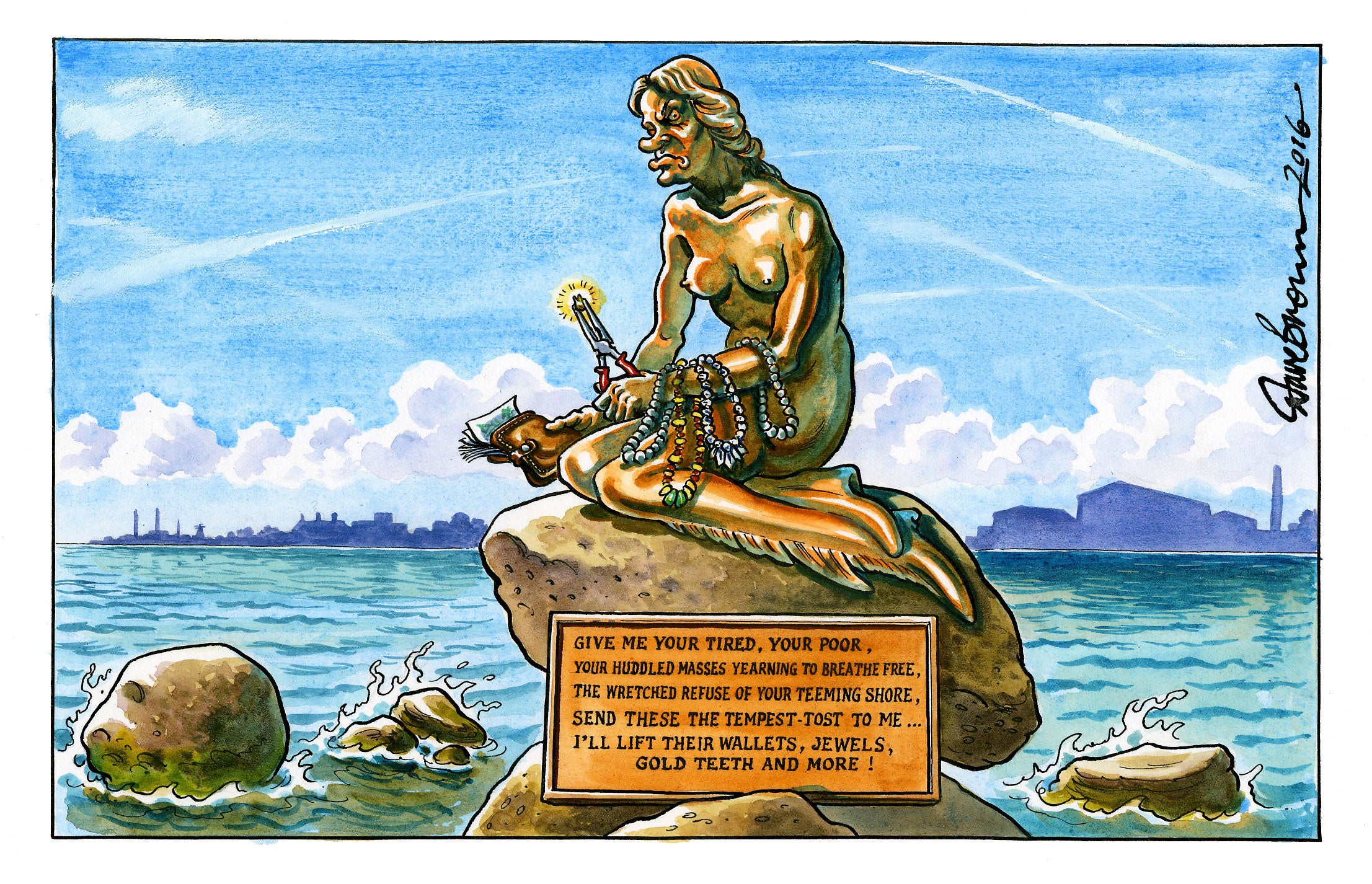
One of these changes, that have attracted a lot of negative attention, is the Danish so-called smykkelov; a statute prescribing Danish border police to seize and secure money and valuable assets (such as electronic equipment or jewelry), of asylum seekers, moving many people's minds to the well known Nazi-german organised robbery of Jewish assets, including the bending out of dental gold from people's teeth post slaughtering in the death camps. Thus, following the adoption of the law by parliament, The Guardian, published a satirical cartoon depicting the Danish PM, Lars Løkke Rasmussen, shown to the left. And another cartoon comment, published by The Independent, depicts the famous Havsfruen statue in the Copenhagen harbour thus:

As a tragicomical aside, these two pieces enraged the former leader of the Danish foremost anti-immigration party, now speaker of the parliament, Pia Kjeaersgaard – otherwise known as one the most fierce defenders of freedom of expression related to debates around the so-called Mohammed cartoons of Jyllandsposten – so that she publicly said they are "not fair" and that the newspapers would "have to withdraw them". And Swedish television aired a report on this, where also "ordinary danes" on the streets of Copenhagen exhibited similar crocodile tears when faced with the bitter taste of their own medicine.

Leaving such pathetic expressions of Danish nationalist hypocricy, however, a more serious accusation of possible hypocritical or double standard thinking has been wielded against those who criticise the Danish law. This since, first, apparently, most countries have various sorts of policies meaning that asylum seekers can be made to pay for things like housing, food, schooling of children, etc. during the trial of their application for asylum. This includes, for instance, Switzerland and, indeed, Sweden. Second, Danish politicians have argued that the Smykkelov is merely a case of applying a principle of equal treatment, as Danish residents (as the residents of most countries) are as a rule required to see to their own financial needs, and may only receive public welfare support when these have run out. I found these arguments interesting, as they basically rest on one sound idea: that there is no principal difference between residents and non-residents of a country. So let's have a closer look at how this way of looking at the issue relates to the Danish law.

1. Let's for starters leave out the option of challenging the principle that people should not receive public welfare support until their private assets have run out. Not because it cannot be challenged, it can for instance be argued that it is pragmatically stupid and inefficient, as it tends to lock people into dependency on public welfare. But only for the sake of the argument, let's leave that discussion to a side for now.

2. Let's also leave out the discussion whether or not it is OK for public agencies to demand payment for the processing of a request for what is a legal right (say applying for a tax subsidy, or requesting help by the police)). I would personally like to quarrel with that notion, but for the sake of argument, let's leave also this issue uncontested.

3. Let's then compare the policies of the mentioned examples, Denmark, Switzerland and Sweden.

  • In the Swedish case, the policy in question regards the daily welfare allowance that an asylum seeker may receive while waiting for a decision on asylum and is described here. In short, it means that in order to receive allowance, you have to demonstrate need, and that includes declaring your assets of economic value. If these are found to be sufficient, no allowance will be granted and the person in question will have to pay their own way. Included in this assessment is also an assessment regarding the need to provide housing, whether or not that should be covered by the allowance, etc. There is in this case also a right to appeal the decision. Of course, if someone lies or cheats in this process, this person acts illegally and can be penalised accordingly.  This makes the conditions of asylum seekers almost exactly on a par with Swedish residents applying for public welfare support, and thus in full compliance with the principle of equal treatment referred to in the Danish discussion.
  • In Switzerland, as reported in the news (here, here, here), the procedure is rather different. In this case, the system is that asylum seekers are required to "hand over" all money exceeding 1000 Swiss francs to the authorities, as a sort of security for the costs of the Swiss state for assessing their application for asylum and providing upkeep, and that these money are repaid to any asylum seeker deciding to abolish the process within 7 months. Thus, there is no active "search and seizure" by police, but a legal obligation (and I assume the asylum seeker can be penalised for breeches of it) where the individual is left to decide how to take this responsibility, and – in addition – the valuables are not necessarily lost, but within the 7 month window function more as a deposition. At the same time, the level of viewing asylum seekers as responsible people just like anybody else is slightly less than in the Swedish case, as the handover is obligatory and the valuables then managed by the state. Thus, asylum seekers are not treated as anyone else, as I doubt that Swiss policy for residents is that these have a legal obligation to give almost all their money to the state, so that the state can then pay their bills. Or, if that is preferred, it is handed over to be kept by the landlord, the telephone company, the electricty provider, the supermarket on the corner, and so on.
  • The Danish case, as I have understood the now decided policy (see links above), moves rather more far away from the idea of asylum seekers as actual people, even remotely on a par with residents of the country. Here the idea is exactly "search and seizure" – as I understand at the discretion of individual police officers and with no legally secured opportunity to get anything back, legal appeal, etc. Basically, the border policy is to take from you what you have if you apply for asylum, and then its gone; what we otherwise like to call robbery. I'm quite sure that this is not how residents' need to pay their way in various instances of Danish life is handled by the Danish state – if that were so, knowing quite a bit of Danish people, I think I'd heard about it by now. My impression is that this civic duty (which we accept for the sake of argument) is handled in Denmark as everywhere else: you receive a notification of payment, that can be challenged and for which you may apply for public support to handle, which you then are left to take responsibility for yourself, and if you don't take it you suffer the consequences. This basically also applies to taxes, although it's a bit of a complex process that proceeds via revenue, appeals, applications for subsidies, etc. The Danish resident is viewed as a person capable of taking responsibility for his or her own actions, with a basic right to dispose of his or her assets as she pleases (within what is lawful) and accountable for the ensuing upshots of his or her decisions. That is, the argument from equal treatment seems very far from supporting anything even remotely resembling the Smykkelov.

So how would the treatment of Danish residents have to look like for the Smykkelov to be supported by the appeal to equal treatment? I suppose something like this:

  • At the end of every month, the police scans you bank account and transfers all of the money there to a state account, used to pay for your rent, your food, your clothes, etc.
  • In this period, the police also breaks into your home and seizes all valuable assets for the same purpose.
  • In addition, there is the regularly seizure of tax for public services, but now at the discretion of individual police officers and no legal room for appeal, etc. 
So now, we all wait for this apparently generally desired reformation of danish civic life. As the title of the danish national anthem goes:

Der er et yndigt land!