Showing posts with label prenatal screening. Show all posts

Thursday, 13 October 2016

New article on prenatal screening online


 Yesterday I received word that the American Journal of Bioethics has accepted a so-called open peer commentary by myself on a coming so-called target-article that presents a seemingly drastic proposal regarding the ethics and policy of prenatal screening using non-invasive sample techniques and so-called whole genome sequencing technology for analysis. I am partly in sharp disagreement with this proposal, partly in full agreement, and rather critical of how the authors of the proposal have ignored crucial parts of the literature and linked complications. The response where I set out my reasons can now be accessed in its original form, before peer review or editing here and here.

***

Friday, 19 December 2014

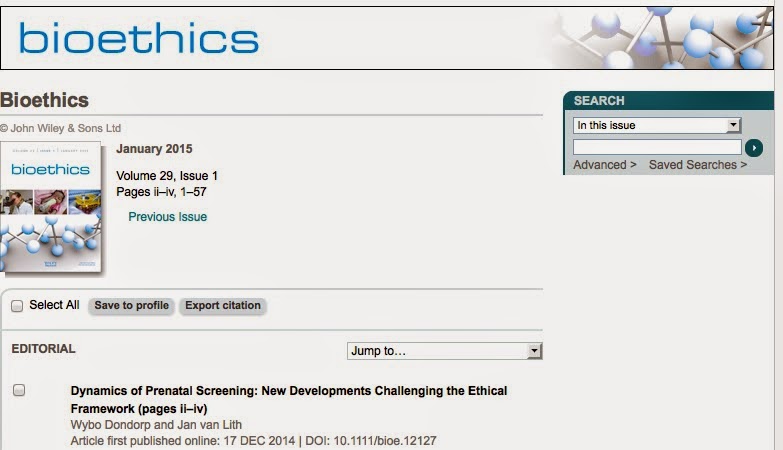
Special issue of Bioethics: Ethical Implications of New and Future Technical Developments in Prenatal Testing and Screening


One of  my core research fields over the years has been reproductive ethics, especially the ethics of genetic and reproductive technology. In my postdoc period, I published a study on the moral roots of prenatal diagnosis, followed by a number of further explorations of the ethics of reproductive technology, genetic testing and medical screening programmes in general. The last two years, this process has come full circle, due to new revolutionary technical developments regarding prenatal testing and related genetic analysis, and the last year or two, I have been busy presenting and discussing issues related to this several times with Swedish medical professional and medical ethical organisations and actors. In the spring of 2013, I was invited to present my views on this topic at a specially convened international symposium at the Brocher Foundation in Geneva, Switzerland. Out of that event now comes a full special issue on the ethical implications of new and future technical developments in prenatal testing and screening of the journal Bioethics, edited by Wybo Dondorp and Jan van Lith, of Maastricht and Leiden universities, respectively:


http://onlinelibrary.wiley.com/doi/10.1111/bioe.2015.29.issue-1/issuetoc

The content, of course, features a developed version of my talk at the Brocher meeting – A New Ethical Landscape of Prenatal Testing: Individualizing Choice to Serve Autonomy and Promote Public Health: A Radical Proposal – arguing that the technical advances of prenatal testing should herald the beginning of the end of of large societal prenatal screening programmes. But the issue also features a large number of other contributions from leading names in the field, e.g. Angus Clarke, Zuzana Deans, Ainsley Newson, Steve Wilkinson and Guido deWert, and the full table of content reads as follows:

EDITORIAL

PAPERS


Thursday, 28 August 2014

I and Other Philosophers/Bioethicists Criticise Richard Dawkins' Tweets and Statements on Abortion and Down Syndrome

http://www.thedailybeast.com/articles/2014/08/28/richard-dawkins-would-fail-philosophy-101.html


So, I don't think anyone missed Richard Dawkins' recent ill-considered and inconsiderate tweet – in response to a personal, cautious reflection by a follower – that abortion of foetuses with Down Syndrome is morally obligatory, as well as the storm of outraged reactions to that and Dawkins' own retrospective apology and defence of his statements. Some reports are here, here, here and here. And Dawkins' own statement of apology and defence is here.


Now, in an article by Elizabeth Picciuto in The Daily Beast, a number of philosophers/bioethicists, among these myself, comment on Dawkins' statement from an intellectual point of view, as well as his attempt at formulating an intellectual and "logical" (a favourite adjective of Dr. Dawkins in his comments on the criticism) defence of it. Spoiler: it's not worth the paper it's written on and, in particular, it's peppered with logically invalid inferences.

On a personal note, I would like to add one thing to what's said in the article: Richard Dawkins' actions in this matter are especially peculiar in light of his former standing as Oxford professor of the public understanding of science. What he has done here is to promote widespread misunderstanding of bioethics, moral philosophy, as well as regarding the health science aspects of Down Syndrome and the rationale of liberal abortion legislation and prenatal diagnosis.

Tuesday, 4 October 2011

New Book on the Ethics of Screening in Health Care and Medicine

So, once again, some self-promotion, but this time not only, since the new book I'm plugging in this way is the result of a truly collaborative enterprise with Niklas Juth, senior lecturer in medical ethics at the Karolinska Institute. Published by Springer, the title of this book is The Ethics of Screening in Health Care and Medicine: Serving Society or Serving the Patient?


 To quote the summary:

Medical or health-oriented screening programs are amongst the most debated aspects of health care and public health practices in health care and public health ethics, as well as health policy discussions. In spite of this, most treatments of screening in the research literature restrict themselves to isolated scientific aspects, sometimes complemented by economic analyses or loose speculations regarding policy aspects. At the same time, recent advances in medical genetics and technology, as well as a rapidly growing societal focus on public health concerns, inspires an increase in suggested or recently started screening programs.
This book involves an in-depth analysis of the ethical, political and philosophical issues related to health-oriented screening programs. It explores the considerations that arise when heath care interacts with other societal institutions on a large scale, as is the case with screening: What values may be promoted or compromised by screening programs? What conflicts of values do typically arise – both internally and in relation to the goals of health care, on the one hand, and the goals of public health and the general society, on the other? What aspects of screening are relevant for determining whether it should be undertaken or not and how it should be organised in order to remain defensible? What implications does the ethics of screening have for health care ethics as a whole?
These questions are addressed by applying philosophical methods of conceptual analysis, as well as models and theories from moral and political philosophy, medical ethics, and public health ethics, to a large number of ongoing and proposed screening programs which makes this book the first comprehensive work on the ethics of screening. Analyses and suggestions are made that are of potential interest to health care staff, medical researchers, policy makers and the general public.
The book is available for purchase via its homepage, linked to above, and as e-book via its Springerlink page, where there is opportunity to sample the contents, parts of chapters, bibliography and the index. More generous sampling is accessible through Google books. Note, that if you are a student, academic, health care professional or official or policy maker, it may very well be the case that you can access a free e-book copy through a library (e.g., your university library) that subscribes to Springerlink!