

Showing posts with label Criminology. Show all posts

Thursday, 7 May 2015

The Philosophy of Hate Crime: Special Section Edited by Myself And David Brax Published By The Journal of Interpersonal Violence


I have been posting a few times over the last couple of years about themes, events and media linked to my engagement in research on philosophical and ethical aspects of hate crimes, hate crime law, and policy relating to this. The engagement originates from my participation in the European Commission funded project When Law and Hate Collide, and I'm now happy to be able to announce the final publication of one of the main academic outputs of this project: A special section of the Journal of Interpersonal Violence on the theme of the philosophy of hate crime, guest-edited by David Brax (my main collaborator in the project) and myself:
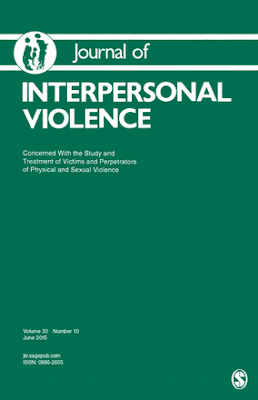

http://jiv.sagepub.com/content/30/10.toc

The section features an unusually (for a philosophy publication) diverse collection of specialists, representing philosophy, ethics, law, sociology and criminology, writing on a wide selection of philosophical and ethical aspects of hate crimes and related policy. The table of content looks as follows:


http://jiv.sagepub.com/content/30/10.toc

David Brax's and my introduction, where the theme of the philosophy of hate crime, as well as the content of the individual contributions, are briefly explained, has been made "open access", that is freely available for reading or download by anyone. If you lack the access (through private subscription or your university library or other institutional link) to read the other contributions, please contact the individual authours to obtain copies of their respective articles!


Thursday, 29 January 2015

The Return of Lombroso? Free Access Article On the Ethics of the Scientific Vision of Screening for Risk of Criminality to Prevent Future Crime


One of my research interests is about the way in which medical science and technology may be used and misused for large-scale societal aims, and how that territory should be understood ethically. In Gothenburg, I am happy to be and have been part of the growing research environment of the Centre for Ethics, Law and Mental Health (CELAM), involving collaboration between forensic psychiatry, criminology, psychology, law, neuromedicine, political and care science, philosophy and ethics. In a freesh article coming out of this collaboration, by myself and CELAM director Susanna Radovic, a family of visionary and currently popular ideas – advocated not least by neurocriminology enthusiast Adrian Raine – about using the science of individual causes of crime for preventive screening programmes are analyzed from an ethical standpoint, connecting to the roots of such visions in the notorious ideas of 19th century Italian criminology pioneer Cesare Lombroso. The abstract runs:

The vision of legendary criminologist Cesare Lombroso to use scientific theories of individual causes of crime as a basis for screening and prevention programmes targeting individuals at risk for future criminal behaviour has resurfaced, following advances in genetics, neuroscience and psychiatric epidemiology. This article analyses this idea and maps its ethical implications from a public health ethical standpoint. Twenty-seven variants of the new Lombrosian vision of forensic screening and prevention are distinguished, and some scientific and technical limitations are noted. Some lures, biases and structural factors, making the application of the Lombrosian idea likely in spite of weak evidence are pointed out and noted as a specific type of ethical aspect. Many classic and complex ethical challenges for health screening programmes are shown to apply to the identified variants and the choice between them, albeit with peculiar and often provoking variations. These variations are shown to actualize an underlying theoretical conundrum in need of further study, pertaining to the relationship between public health ethics and the ethics and values of criminal law policy.

We have been fortunate to possess the funds of making the article so-called open access, meaning that it is now free for viewing and download by anyone – no need for subscription or the payment of any fees.

So if the topic of how medicine, science and technology can be used, for better of for worse, for preventing crime, and what are th ethical implications of such possibilities, feel free to sample our attempt at getting an initial grip on trhis topic, here. And should you want to share it along, or post it on a blog or a forum or in an archive, the open access license permits you to do so, as long as no commercial exploitation is involved.

Wednesday, 31 July 2013

Slides to Two Recent Talks Connecting the Themes of Ethics, Crime and Psychiatry are Now Online

Just to inform that the slides to my two talks at the 33rd International Congress of Law and Mental Health, held in Amsterdam earlier this summer, are now available online for viewing, download and sharing via my Academia.edu site. Both talks represent work in progress, where I am in the beginning of combining thinking on different topics that I have been touching on in isolation before, but which are nevertheless related through their connection to certain aspects of criminal law policy connecting to medical views of human nature.

They are:

1. The Return of Lombroso? Ethical and Philosophical Aspects of  (Visions of) Forensic Screening

Abstract
Italian nineteenth century criminologist Cesare Lombroso is notorious for his seminal ideas about criminality and anti-social behaviour resulting from physiological anomalies that should be detected by society and used for forensic preventive purposes. After an extended period of disrepute following World War II, similar ideas have been resurrected in psychiatry, genetics, neurology and criminology in the past decade or two. In particular, there is a growing focus on early detection and application of preventive measures. This development actualizes a complex web of ethics and policy issues having to do with the well-known fact that screening and prevention in the health area are far from ethically clear-cut activities and actualize vivid prospects of doing extensive harm to individuals as well as society. Also, taken to its extreme, it actualizes the idea of using prenatal or preimplantation testing to preselect against children with a predisposition for criminal or antisocial behaviour. In the forensic case, such screening-prevention strategies will connect further to a complicated issue about the proper use of risk-assessment models for societal decision-making for precautionary purposes. Based on former work in all of these areas, this presentation will outline and analyze the basic issue of the defensibility of activities of this sort, with the perspective of forestalling unintentional harm to individuals and society.

And.....

2. Hate Crime, Mental Disorder and Criminal Responsibility

Abstract
Hate crimes are ordinary crimes committed in connection with a negatively prejudiced, biased, disparaging, or antagonistic attitude towards the victim in terms of a perceived membership of a social group. Some hate crimes are elaborate political acts of terror or elaborate persecution, some are so-called “hate speech”, but the overwhelming majority are instances of mundane criminality, involving everything from murder to theft and harassment. Hate crime policies rest on the idea that the bias or “hate”feature make such crimes worse, and that offenders for this reason should be held more firmly responsible. At the same time, the attitude of making a crime into a hate crime involves more or less distorted ideas about reality, together with a willingness to transgress social norms on that basis. In some cases, these views amount to major delusions, resistant to rational scrutiny. In other cases, we may move closer to a point where the belief-desire cluster can be seen as ordinary negligence. Thus, many hate crimes have features that may be argued acting to diminish responsibility according to standard ideas in the philosophy of punishment. The presentation maps underlying value conflicts, tensions, and incoherence in legal practice connected to this complexity of criminal law.

Enjoy for what it's worth!