Showing posts with label Sweden. Show all posts

Friday, 27 March 2020

New Swedish Guidelines for ICU Priority Setting in Exceptional Circumstances


This post was updated March 30, 2020 with criteria for rationing outside ICU!

During the last two weeks, I have, together with a bunch of philosophy and bioethics colleagues specialised on these kinds of questions not only in theory but also in practice, contributed to a speedy development of of new central guidelines on ICU priority setting and resource allocation from the National Board of Health and Welfare (one of the central governing authorities of the Swedish healthcare system). The guidelines address exceptional circumstances, such as an unusual high pressure of cases that exceeds normal capacity, and are, of course, prompted by the Covid19 pandemic. Lars Sandman, head of the national Center for healthcare priority setting, led the work, and it took a little less than two weeks to go from zero to end product. Besides philosophers, the National Council for Medical Ethics, representatives of the Ethics Delegation of the Swedish Society of Medicine, and ICU specialist consultants have contributed.

As the legal language of Swedish public documents is Swedish, this is also the language of the guidelines. This full version can be read and downloaded here. But, as there has been quite a bit of international interest, here is a short English summary by myself (ie. this is not an official translation from NBHW):

BACKGROUND
Health care priority setting is already regulated by special laws, where non-instrumentality, equal treatment and non-discrimination, priority based on patient need only, and ban on unnecessary waste of resources are the key principles decided by the Swedish Parliament since before.

APPLICATION IN THE GUIDELINES
First of all, ICU capacity should be strengthened by rationing less acute or important care, or care than can be postponed without severe consequences (and without disturbing management of the pandemic), so that an exceptional ICU situation is avoided as far as is practically possible. There is a specific appendix in the full guidelines setting out rationing principles to this effect (see below).
In exceptional circumstances, ICU should focus on patients where the treatment can do the most good, thus focusing more on the prognosis of the treatment than the severity of the condition (both dimensions of patient need). This means that indication for ICU may be strengthened to exclude some patients with severe conditions that are given ICU in normal circumstances to give extra time for planning and family contact.
While the legal regulation excludes chronological age as priority basis in its own right, it allows for life expectancy (if given successful care) to be part of the assessment of the patient need for a resource (besides the severity of the condition and the immediate prognosis of the treatment). Factors to assess life expectancy in the clinic are:
  • Extent and severity of vital organ failure
  • Extent and severity of pre-existring co-morbidities
  • High chrononological age in combination with a bad prognosis after intensive care
Priority groups are patients with:
Priority 1
Severe condition or injury with >12 months life prognosis, otherwise meet indication for ICU, and don't suffer severly decreased life expectancy (see above). If there is necessary to make a choice between patients in this group, patients with a general longer life expectancy (higher biological age) should be given priority.
Priority 2
(a) One or several serious systemic diseases with extensive functional impact, and/or (b) expected survival of 6-12 months based on pre-existing underlying disease.
Priority 3
Bad prognosis in ICU, and where ICU is normally undertaken only to provide time for planning, or family contacts.

These priority groups should ground resource allocation both when assessing new patients, and when reassessing patients admitted to ICU care, and may therefore also ground discontinuation of ICU care, to free resources for new patients with a higher priority.

Patients who are denied or taken off ICU should receive best possible palliative and other care to manage their care need given the ICU resource allocation.
There are also some sections on management of staff ethical stress, and of how to involve patients and family in the decisions.

COMMENTS BY MYSELF
In the preparatory stage, it was discussed whether or not the guidelines should include the feature of being crucial for life saving societal functions as a further item to sort among those in priority group 1. There seems to have been agreement that the requirement of equal treatment for all patients with similar need of care could support this idea if the circumstances are extremely prolonged (as loss of critical staff could then undermine the treatment prospects for future patients). However, the general assessment was that the crisis possibly caused by the Covid19 pandemic for Swedish ICU care would probably not be of this nature, especially in view of the time it would take for someone to return to work after a very critical ICU episode. Should the situation change, the guidelines may be amended to this effect.

RATIONING OUTSIDE OF ICU
These are the rationing criteria for healthcare outside ICU, in order to free capacity for ICU in an Covid19 crisis, mirroring the priority setting criteria above, and based on the same legal principles. They apply on the condition that rationing can free resources/capacity for ICU, and that the rationing does not impede communicable disease control work: 
RATIONING GROUP 1: Elective procedures that may be postponed without deterioratiuon of the condition; 
GROUP 2: Elective procedures that may be postponed without threat to life, abeit with negative effect on QoL: 
GROUP 3: Elective or acute procedures that are unlikely to restore health and likely to lead to prolonged care with risk of ICU need; 
GROUP 4: Acute procedures where postponement will affect QoL during the delay, but not lead to a worse longterm prognosis; 
GROUP 5: Acute procedures where postponement will affect QoL also in the longterm, but not be a threat to survival. 

*

Sunday, 9 October 2016

New article online: Conscientious Refusal in Healthcare: The Swedish Solution


Indeed, as flagged before, I have a new article published online in the Journal of Medical Ethics on the topic of the Sweden's longstanding policy on conscientious objection by health professionals. I briefly describe the policy and its background and chart some recent challenges to it.

The published article, which is to be included in a coming special issue on conscientious objection, is here.

Preprints for free reading and download those of you who lack institutional access to the JME are here and here.

***

Saturday, 30 January 2016

On "Smykkeloven": The Danish Policy to Seize Personal Valuables and Money from Asylum Seekers


I suppose no one has missed the fast and radical transformation of European refugee and migration policy, following both the vast increase of refugees wishing to seek asylum in European countries during 2015, and the ongoing tragedy of people being killed while attempting to cross the the borders into the European fortress. In my earlier post on this, the focus has been on what occurs around the EU external borders and the inability of the EU to decide and enact a joint policy of sharing asylum seekers to defuse the problem. However, the transformations during the last year includes some rather drastic measures also inside EU itself. Not least by my own government, which has re-installed internal border controls between Sweden and Denmark, Germany, Poland, and so on, and the issuing of a transporter accountability legislation, leading to ID-controls akin those already routine at airports also at ports, train stations, etc. in Denmark and Germany. The Swedish turn-around rather quickly gave rise to a domino effect southwards within the EU, and quick changes of policy have occurred in Denmark, and are being announced in Germany as well. I predict that very soon we will be back at square one were we where when the horrific news of the mass deaths in the Mediterranean started to gain attention a few years back.

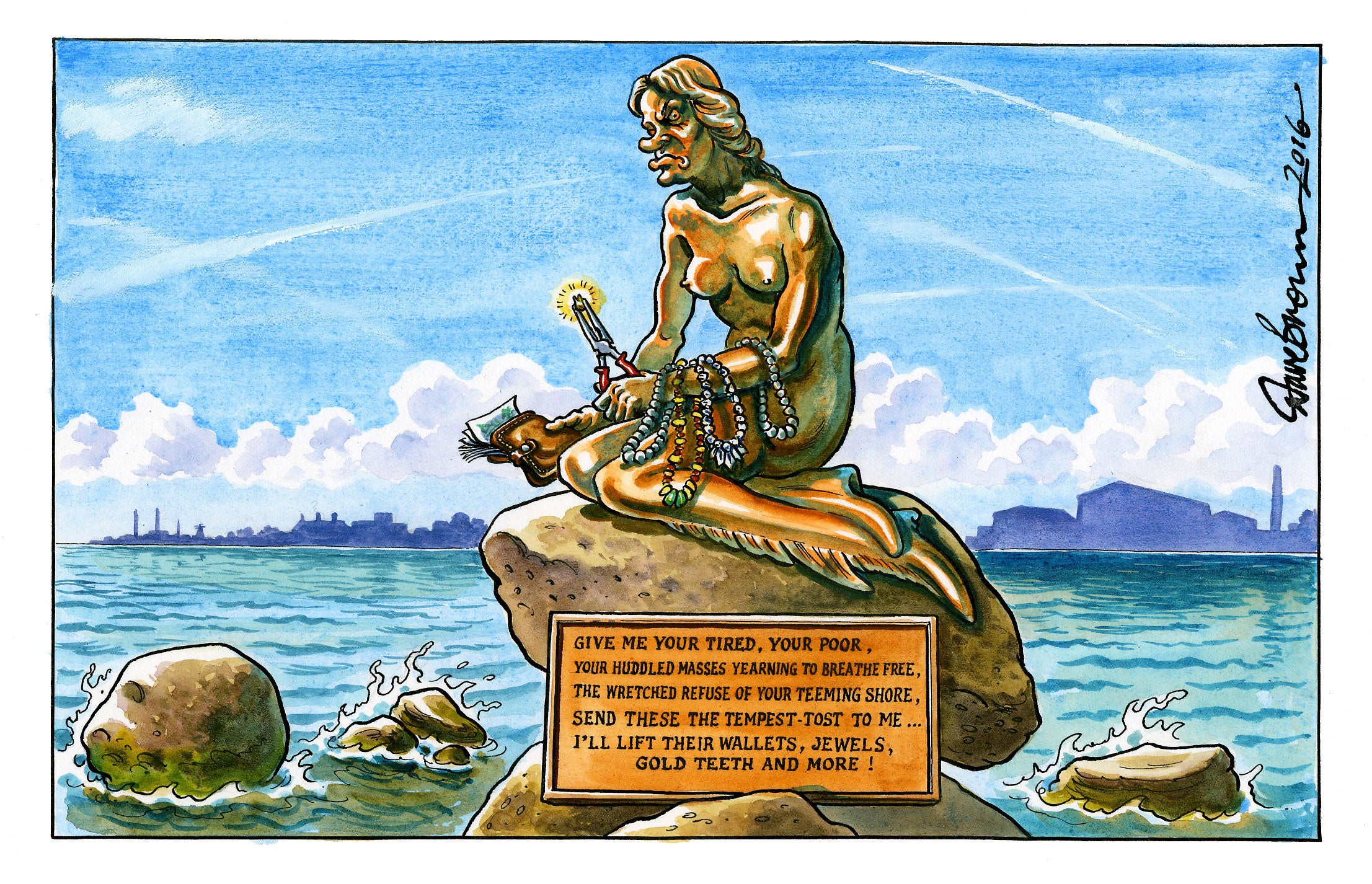
One of these changes, that have attracted a lot of negative attention, is the Danish so-called smykkelov; a statute prescribing Danish border police to seize and secure money and valuable assets (such as electronic equipment or jewelry), of asylum seekers, moving many people's minds to the well known Nazi-german organised robbery of Jewish assets, including the bending out of dental gold from people's teeth post slaughtering in the death camps. Thus, following the adoption of the law by parliament, The Guardian, published a satirical cartoon depicting the Danish PM, Lars Løkke Rasmussen, shown to the left. And another cartoon comment, published by The Independent, depicts the famous Havsfruen statue in the Copenhagen harbour thus:

As a tragicomical aside, these two pieces enraged the former leader of the Danish foremost anti-immigration party, now speaker of the parliament, Pia Kjeaersgaard – otherwise known as one the most fierce defenders of freedom of expression related to debates around the so-called Mohammed cartoons of Jyllandsposten – so that she publicly said they are "not fair" and that the newspapers would "have to withdraw them". And Swedish television aired a report on this, where also "ordinary danes" on the streets of Copenhagen exhibited similar crocodile tears when faced with the bitter taste of their own medicine.

Leaving such pathetic expressions of Danish nationalist hypocricy, however, a more serious accusation of possible hypocritical or double standard thinking has been wielded against those who criticise the Danish law. This since, first, apparently, most countries have various sorts of policies meaning that asylum seekers can be made to pay for things like housing, food, schooling of children, etc. during the trial of their application for asylum. This includes, for instance, Switzerland and, indeed, Sweden. Second, Danish politicians have argued that the Smykkelov is merely a case of applying a principle of equal treatment, as Danish residents (as the residents of most countries) are as a rule required to see to their own financial needs, and may only receive public welfare support when these have run out. I found these arguments interesting, as they basically rest on one sound idea: that there is no principal difference between residents and non-residents of a country. So let's have a closer look at how this way of looking at the issue relates to the Danish law.

1. Let's for starters leave out the option of challenging the principle that people should not receive public welfare support until their private assets have run out. Not because it cannot be challenged, it can for instance be argued that it is pragmatically stupid and inefficient, as it tends to lock people into dependency on public welfare. But only for the sake of the argument, let's leave that discussion to a side for now.

2. Let's also leave out the discussion whether or not it is OK for public agencies to demand payment for the processing of a request for what is a legal right (say applying for a tax subsidy, or requesting help by the police)). I would personally like to quarrel with that notion, but for the sake of argument, let's leave also this issue uncontested.

3. Let's then compare the policies of the mentioned examples, Denmark, Switzerland and Sweden.

  • In the Swedish case, the policy in question regards the daily welfare allowance that an asylum seeker may receive while waiting for a decision on asylum and is described here. In short, it means that in order to receive allowance, you have to demonstrate need, and that includes declaring your assets of economic value. If these are found to be sufficient, no allowance will be granted and the person in question will have to pay their own way. Included in this assessment is also an assessment regarding the need to provide housing, whether or not that should be covered by the allowance, etc. There is in this case also a right to appeal the decision. Of course, if someone lies or cheats in this process, this person acts illegally and can be penalised accordingly.  This makes the conditions of asylum seekers almost exactly on a par with Swedish residents applying for public welfare support, and thus in full compliance with the principle of equal treatment referred to in the Danish discussion.
  • In Switzerland, as reported in the news (here, here, here), the procedure is rather different. In this case, the system is that asylum seekers are required to "hand over" all money exceeding 1000 Swiss francs to the authorities, as a sort of security for the costs of the Swiss state for assessing their application for asylum and providing upkeep, and that these money are repaid to any asylum seeker deciding to abolish the process within 7 months. Thus, there is no active "search and seizure" by police, but a legal obligation (and I assume the asylum seeker can be penalised for breeches of it) where the individual is left to decide how to take this responsibility, and – in addition – the valuables are not necessarily lost, but within the 7 month window function more as a deposition. At the same time, the level of viewing asylum seekers as responsible people just like anybody else is slightly less than in the Swedish case, as the handover is obligatory and the valuables then managed by the state. Thus, asylum seekers are not treated as anyone else, as I doubt that Swiss policy for residents is that these have a legal obligation to give almost all their money to the state, so that the state can then pay their bills. Or, if that is preferred, it is handed over to be kept by the landlord, the telephone company, the electricty provider, the supermarket on the corner, and so on.
  • The Danish case, as I have understood the now decided policy (see links above), moves rather more far away from the idea of asylum seekers as actual people, even remotely on a par with residents of the country. Here the idea is exactly "search and seizure" – as I understand at the discretion of individual police officers and with no legally secured opportunity to get anything back, legal appeal, etc. Basically, the border policy is to take from you what you have if you apply for asylum, and then its gone; what we otherwise like to call robbery. I'm quite sure that this is not how residents' need to pay their way in various instances of Danish life is handled by the Danish state – if that were so, knowing quite a bit of Danish people, I think I'd heard about it by now. My impression is that this civic duty (which we accept for the sake of argument) is handled in Denmark as everywhere else: you receive a notification of payment, that can be challenged and for which you may apply for public support to handle, which you then are left to take responsibility for yourself, and if you don't take it you suffer the consequences. This basically also applies to taxes, although it's a bit of a complex process that proceeds via revenue, appeals, applications for subsidies, etc. The Danish resident is viewed as a person capable of taking responsibility for his or her own actions, with a basic right to dispose of his or her assets as she pleases (within what is lawful) and accountable for the ensuing upshots of his or her decisions. That is, the argument from equal treatment seems very far from supporting anything even remotely resembling the Smykkelov.

So how would the treatment of Danish residents have to look like for the Smykkelov to be supported by the appeal to equal treatment? I suppose something like this:

  • At the end of every month, the police scans you bank account and transfers all of the money there to a state account, used to pay for your rent, your food, your clothes, etc.
  • In this period, the police also breaks into your home and seizes all valuable assets for the same purpose.
  • In addition, there is the regularly seizure of tax for public services, but now at the discretion of individual police officers and no legal room for appeal, etc. 
So now, we all wait for this apparently generally desired reformation of danish civic life. As the title of the danish national anthem goes:

Der er et yndigt land!


Sunday, 29 November 2015

Addendum Re. Using Medical Methods to Determine the Age of Unaccompanied Refugee Children


After my post on this issue a few days ago, I've debated the issue with a number of people from within medicine and also bioethics in different fora.

Due to the presence of significant uncertainties of the methods debated, my suggestion was that use of this methods should be amended by the following methodological rule (assuming 18 to be the age of adulthood, if it is different we may simply insert another variable for that):

... for any method, M, for the assessment of the age of a person, P, with a margin of error +/- X years, M is taken to indicate adulthood if, and only if, its result is 18+X years or higher, and otherwise taken to indicate childhood

Here are a few points that may be added to the complexities of this particular issue:

1. The nature of the uncertanties
Some have argued to me that the methods are not only uncertain in a way possible to describe in terms of a margin of error. One reason for this put to me is that besides the usual margin of error within the dimension of a variable, there is also the background confidence interval behind this margin, and the known effect of having this confidence deteriorate considerably when aggregated population probabilities are projected onto individual cases. I, of course, do not deny that there is also this source of uncertainty, but as far as I can see, my formula above can easily include that: X can be the aggregation of both these uncertainties (this was my original thought as well). This probably means that X becomes considerably larger than 4 (the number used in the example in the original post, based on claims by critics of the model). However, this in no way undermines my suggestion, as this will probably mean that all unaccompanied refugee children will most likely be determined to be children (and, if there are any people like that, in addition a number of refugee adults who falsely claim to be children). That is, the best interest of children, as well as the proper priority of legal provisions is upheld. Suppose, for instance, that the margin of error, accounting for all sources of uncertainty, becomes +/- 15 years. Then my rule says that P is to be considered an adult if, and only if, M finds P to be 33 years or more.

Another claim has been that some of the methods depend on the existence of relevant tables and charts or background data, and that such are missing in this case, meaning that the methods are not really uncertain, there is no method at all. The bewildering thing is that the same people are at the same time officially repeating the argument that the methods are uncertain and have unacceptably wide margins of error. These two claims are, of course, inconsistent; if it's not possible to have any result at all, there is no margin of error, and if there is a margin of error there is some results that create this margin. If it turns out that, in fact, the variable X (accounting for all kinds of sources of uncertainty), cannot be given any empirically based numerical estimate, I concede that my rule is inapplicable. However, if even an interval numerical estimate can be grounded, my rule can be used, by simply adding (supported by the same basic principles as before) that, the high extreme of this interval should be used to define X (in order to err in the right direction). Again, this may mean that the method will determine all tested as children, but, as already argued, it is difficult to see what the ethical or legal problem with that would be.

2. Professional Health Care Ethics and Ethics
Another aspect that has been raised is the fact that my suggestions means that health care professionals pragmatically accommodate to flawed public policies in the best interest of concerned parties (i.e. the children). This is wrong, some say, health care professionals should demand to regulate themselves and never do anything they themselves collegially don't find suitable to do, not even if this is harming third parties. Some have even gone so far at to claim that it is irresponsible of a health care professional to ever act the slightest in any other interest than his or her patient's.

The latter would, of course, mean that we would have to abandon all public health practices, communicable disease management, forensic medicine, large segments of insurance and sports medicine, and not least the involvement of doctors in issuing certificates underlying decisions by public authorities, such as sick leave or work-related disability benefits, and so on. Since health care professional organisations have as yet made no move whatsoever in such directions, I trust that this is not the line underlying the criticism in the present case. In other words, formalised professional health care ethics already accepts a number of cases where medical methods are used to other ends than the best interest of patients and many of these uses are being pragmatically accommodated to still make the best out of an imperfect thing. A very clear illustration is the assessment of "ability to work" nowadays made routinely by medical doctors in many countries, strategically adapted not to harm their patients while still abiding by required formalities.

It is thus unclear to what extent the principle of never doing anything to right the wrongs of public policies is a part of professional health care ethics. Even more unclear is if, had it been such a part, it would have been ethically defensible. To illustrate with the issue at hand, suppose that the health care professional community was to refuse to participate in the practice decided by the Swedish government. This may have three outcomes: (a) the government and parliament creates a legal room for some other class of officials to use the methods (not using my rule), (b) no method is used, (c) alternative suggested methods based on psychological models are used.

  • If (c) is the outcome, the issue reappears, as also these methods can be expected to have margins of error, sources of uncertainty and so on. Then my rule can be used to secure that determinations err in the right direction.
  • If (a) is the outcome, the results for the persons concerned, namely the children, is worse than if the profession had chosen to participate, using my rule to secure that they act solely in the best interest of the children, although also accommodating societal requests.
  • If (b) is the outcome, the situation stands that unaccompanied refugee children where there is uncertainty as to whether or not they are children, will not be given their rights as children.

Now, compare this with (d): health professionals decide to pragmatically accommodate, and use the methods, amended by my rule.
  • If (d) is the outcome, the concerned children's interests and Sweden's legal needs are better served than if any of (a) and (b). If these children are seen as patients, it would then be in their best interest to go for (d) rather than (a) or (b). If there is an option (c), this is even better, provided that my rule is used, but if not it may be better for the patients to go for (d).


3. The Ethics of Clean Hands, Politics of Power and Professional Integrity as Strategic Tool
Against this form of reasoning, some debaters I've talked to have claimed that the downsides for refugee children of the options (a) and (b) (as well as (c) without my rule) cannot be laid at the door of health professionals, but is the sole moral responsibility of the government. That is, they apply the standard of an "ethics of clean hands", denouncing responsibility for bad outcomes they could have avoided by acting differently just because the same is true of some other acting party (here, the government). This is like when the car driver, displeased with the rule that gives pedestrians priority at crosswalks, blames the government while electing to run people over, who cross motivated by the rule. Not very splendid ethics, I'd say.

Another version of this reasoning instead comes in the form of a political power bidding in the name of professional autonomy. It is simply the claim that health professionals should insist on the right to decide for themselves what standards they act on. While this is understandable (we all would like the privilege not to give a damn about the opinions of others, don't we?), it either comes without any underlying defense, or is compatible with sometimes choosing to compromise with other parts, interests and powers in society. As mentioned, the latter seems what in fact is happening in a number of areas, so then the question moves to what reasons pro or contra are present in the area at hand. Here, I have argued that (d) is the superior position.

The same outcome seems to ensue when analysing a final (and, to my view, better) variant of this sort of argument. Instead of an empty insistence on professional autonomy at all cost, this argument points to the political importance of professional integrity as a strategic tool in certain areas. The most obvious of these are torture, capital punishment and military interrogation. Here, the profession has adopted zero tolerance policies, which are thought to have an accumulated preventive effect, as these practices in various ways "need" the participation of doctors. However, this point does not demonstrate that age determination of unaccompanied refugee children belongs to this set of absolutely prohibited practices. As those who criticise the presently proposed methods also say that they could accept methods with a better degree of precision and exactness, it doesn't seem that they are trying to argue this in the present case. Which is understandable, as that would mean arguing against any claim to special considerations of the interests and rights of children.

In sum, therefore, unless it is demonstrated that there is no method at all that could produce any sort of empirically grounded numerical estimate (even in the form of a wide interval) in this area, my suggestion holds up to scrutiny. In fact, it is better supported by both professional health care ethics and more general ethical analysis, than alternative suggestions.

***


Wednesday, 25 November 2015

On Using Physiological or Biomedical Methods to Determine the Age of Unaccompanied Refugee Children

  In my country, there has for some time been a lot of political debate around how to handle the rising number of refugees from, primarily, Syria/Iraq, Afghanistan and North Africa. This as the pressure on border EU member states, and the impossible situation of trying to hold back people on the run from intolerable circumstances that I blogged about not so far ago, has meant that much more people are now entering Sweden to seek asylum in a short time, as most other member states are unwilling to participate in a scheme of sharing the economic and logistical load it means to process these requests in a way required by human rights and international agreements, as well as legal security. For, while there is no such thing as a right to have asylum, to seek it is an absolute international legal right, and already this means that a receiving country has a lot of obligations. And one group of refugee people towards which such obligations are especially strict are unaccompanied children, and many of these who actually arrive to Sweden are mostly in their teens, usually lacking certifiable identity documentation.

Now, yesterday, the Swedish government, pressed by the logistic and organisational pressure, declared that the already announced difficulties had now become intolerable, and that a number of measures was to be put into place to complement the already a few weeks back instigated active border controls (which, until then, had been non-existent in accordance with the so-called Schengen accord on free internal EU mobility). The move is very controversial, and many doubt that the logistical and organisational reasons cited are the only ones behind it, if nothing else, worries about how political opinion will shift in the presence of my country's anti-immigration, semi-racist party, the Sweden Democrats (see here, here and here), are bound to have played a part, as these are presently laying mostly low to wait things out after some botched attempts to take the initiative, and being actively ignored by the other parties, as it has announced that its only idea is to close the borders entirely. One thing is entirely clear, though, the problem behind the decision is neither one of money, nor one of space, Sweden has plenty and plenty of both of those, and neith is it about "volumes", as the term goes, but mostly about flow; not how many people arrive, but how many arrive in a short time.

 One of the measures decreed by the Government concerns the unaccompanied refugee children, and it is to (re)start using certain physiological or biomedical methods to ascertain the age of these children. No one is debating the need for such ascertaining, but the debate is about this particular proposal, as many Swedish medical specialists (for two international sources, see here and here) also the medical research specialist organisation Swedish Society of Medicine, point out that the proposed methods are very uncertain and have wide margins of error, up to 4 years plus or minus. This means that the risk is imminent that a child of 14 is determined to be an adult, and that Sweden would thus knowingly risk to default on its particularly strong and demanding obligations towards children. The fact that there is also a risk that some 21-year olds come to enjoy these special protections and care is a non-issue in that light. However, the government seems insistent, so what should be done? General refusal of doctors and other medical staff to participate in what has been proved to be unprofessional practice? (as they would seem to be required to do by the Swedish health and Medical Services Act)? This is certainly a live option from a medical ethical standpoint as well, although it also means that most unaccompanied refugee children are left without proof of age.

However, there is another solution, which would satisfy both the government's decree, the worries from the point of view, the need for unaccompanied refugee children to have their age ascertained, and the overwhelming reason to have Swedish policy abide by its own legal standards. This solution is, moreover, applicable to any method for this purpose. It rests on the assumption that for Sweden to meet its own legal requirements is a primary consideration that trumps other reasons and interests in this area. This means that overestimating a refugee child's age and assess this person as adult is far worse than underestimating a refugee adult's age and assess this person as a child. Based on this premise, we may now argue that, therefore, using a method for age assessment in this area that is uncertain, we should use it in a way that makes us err in the right direction. That is, to the extent that we draw faulty conclusions, these should rather be the wrongful classification of adults as children than the wrongful classification of children as adults. this rules gives us access to a simple mathematical solution to the conundrum: we simply adjust the conclusions drawn with the help of the method in light of its uncertainties, so that we are certain to err in the right direction. Thus, for any method, M, for the assessment of the age of a person, P, with a margin of error +/- X years, M is taken to indicate adulthood if, and only if, its result is 18+X years or higher, and otherwise taken to indicate childhood. Regarding the methods cited earlier, this would mean that a person who is apparently an unaccompanied refugee child (who lacks reliable documents), is concluded to be a child, as long as these methods do not declare the age to be 22 years or higher.

As said, this solution makes it possible to abide by the governmental decision, while acting inside medical professional and ethical boundaries, and while both securing the need of refugee children to have their age determined to claim their rights, and the paramount need for the state of Sweden to honour its own legal and international obligations.

Due to debates related to this post in other fora, here's an addendum I made a few days later.

***


Friday, 20 November 2015

What Is A Terrorist Threat, And How Should One Respond To It?


The other day, following the recent horrid events in Paris, linked to several temporally closely aligned similar attacks by Daesh, e.g., in Lebanon and Iraq, apparent intelligence on several other planned attacks throughout Europe, and specifically that a possible Daesh operative had entered Sweden to organise a large.scale attack of some sort, my country raised its official terrorist threat level from 3 to 4 on a scale that ends at 5. One named suspect of preparation of terrorist crime has now been apprehended, but the police and security organs apparently continue to search for others, and the government has been clear that this single factor will not by itself motivate downgrading the threat level. At the same time, several voices criticise the development either for coming much too late (claiming, among other things, that the knowledge of the presence of Daesh sympathisers in the country should have been enough), or for being misdirected, as actual terror attacks in Sweden (save one) tend mostly to be domestic extreme right wing nationalist/racist (targetting refugees and street begging EU migrants, people of visibly Muslim or Roma identity or Middle East or African descent, their living quarters, and so on), or is exaggerated and bound to create more problems than what it prevents or fixes. It struck me that many of these reactions seem based on ignoring or fixing on only selected aspects of what is technically known as a risk analysis. For this is basically what the assessment of the level of terrorist threat by a state is about: assessing certain risks and cost of events classified as terrorist attacks, as well as various actions possibly to take in response to various such levels of risk, and to evaluate on that basis what to do.

A disclaimer before I start: the putative facts about the seriousness of typical types of terrorist attacks, and the likelihood of different types of such attacks, are, of course, open to revision in the face of facts – although, as will become clear, less obviously according to what standard of evidence. All of the aspects described are part of the discussion of the ethical basis of environmental and technological risk policy that I undertake in my book The Price of Precaution and the Ethics of Risk.

First, there is the two main dimensions of the concept of risk itself: the probability and harm dimensions. A risk is always the possible (and to some extent likely) occurrence of some type of variably harmful event. In risk analysis, the magnitude of a risk is determined by a combination of these two dimensions, so that a low probability may be balanced by a serious harm-level, and the other way around. Already this simple analytical unpacking points to a factor that may seem to be at work in the reaction to the raised Swedish terror threat level. Some people focus mainly on the likelihood dimension, and then would hesitate to criticise that new evidence and circumstances changes the assessment, or would rather have seen an earlier raised level in view of the actual wave terror attacks in the form of typical "lone wolf" deeds, and thus a concentration on extreme right wing violence rather than its Islamistic sibbling. Others focus instead on the harm dimension, and then lets the demonstrated vastness of the damage of attacks such as the one in Paris dictate the risk assessment, also when the evidence of likelihood is very weak. This may then motivate the position that, knowing that Daesh and similar groups do have had attacks such as the one  in Paris on its theoretical agenda for a long time (and carried out i the Iraq and Syrian theaters). With the notable exception of Anders Behring Breivik, although much more frequent and actually realised rather than merely theoretically imagined, the right-wing extremist deeds, while clearly terrorism in the sense of attempting to spread fear for political purposes through the use of violence against civilians, tend to be more restricted in its consequences than the large scale massacres that have now occurred and known to be on the Daesh agenda.

Second, there is the way in which different such combinations and magnitudes of risk are evaluated, or seen to support various courses of action. Here, a number of additional issues linked to the assessment of the risk magnitude is actualised, namely:

Third, how the constituents of the risk (its probability level and its harm level) are evaluated in terms of how much we should care about it. This gives another way in which we may get a similar output that was just described above, even if all agree of the risk magnitude. This since risks with the same magnitude may still be evaluated differently, e.g. due to being made up of very low probability, or very serious potential harm. here, one may also want to pay attention to the context, such as if one is making the assessment from the position of already being burdened by much risk of different kind. So if the potentially worst terror threat are the least likely, and the most likely ones the least serious (relatively speaking, of course), we may again get differences of opinion of a similar sort, but now more clearly based on differences of values rather than appraisal of fact.

Fourth, how the opportunity costs of different actions in response to a risk assessment are evaluated, that is, what is lost and risked by taking these various actions rather than other ones. Here we may spot a number of ways in which assessments may differ, although not basically disagreeing on the risk assessment (such disagreements may, of course, also be added to other disagreements). For instance, several argued against extensive action in face of the wave of apparently extreme right wing nationalist attacks against Swedish actual or in preparation asylum shelters that it would not be worth the costs it would mean to have effective guarding of each one of them. At the same time, there has been no or very little hesitance to mobilise extensive police and security forces to guard potential targets and just demonstrate the presence of the state organs to effect public calm in the wake of the new threat level. But there has been some criticism, for instance, from one of the country's most prominent terrorist experts, Magnus Norell, who claimed that even if there is a raised threat, the actions in response to it and the very act of public threat level raising itself mostly creates unnecessary worry and fear, that is the very effect aimed for by terrorists. One may also wonder how effective the guarding by police of places like train stations and main squares of large cities are, provided that combatants such as those responsible for the Beirut and Paris attacks are set on targeting them. In both cases, this would also mean that these resources are, in fact, wasted. In that light, posting armed guards outside every asylum shelter to guard against a wholly different kind of terrorists targeting these may suddenly seem as a more effective and less costly measure. This aspect, of course, has many more sides, but this only goes to show how the evaluation of options in response to a described threat, and the opportunity costs attached to them may be used to inject the issue with limitless complexity.

Fifth, there is the issue of the evaluation of evidence, underlying the probability estimates at work in all of the considerations pointed to above Here, we may see a number of differences on what type of evidence is to be given the most credence: Actual similar past events is one model, following the "frequentist" ideal in decision theory. That would, in the present case, probably speak in favour of a much higher probability for more extreme nationalist right wing terrorism against refugees, migrants and their quarters in Sweden, as this is what wa have mostly had in the past (especially the very close past). Another model is to instead trust qualified estimates, by appointed experts, who may then, if they so prefer, let other reasons than frequentist ones affect the probability estimate. For instance, even if there has been no, or relatively very few, attacks of the type known to be on the Al-Qaeda and Daesh agendas, the fact there are such attacks on this agenda combined with the presence of people who sympathise with these movements in the country, and maybe witness statements that some such person in the country has been mentioned to plan or want to plan such an attack, may be used as evidence. Some of that evidence may be broken down into an indirect frequentist argument, as it points to factors believed to have been active in relevantly similar past events elsewhere. But a substantial portion would also seem to be about subscribing to certain qualitative and evaluative assessments, such as choosing to trust certain bearers for information as credible, viewing certain events as relevantly similar in spite of notable dissimilarities, and so on. The point is that the more of this latter sort of probability grounding is used, the more room to assess as probable also events of which there have been no very similar precedent.

Sixth, there is the issue of the how much evidence (given some standard of its quality of the sort just described) should be required for a credible estimate, and for taking action. This factor is basically about how long we should wait and amass evidence to have a more well-founded risk assessment, in view of the potential costs of being to late to act effectively against the threat (if there is any). Also this aspect seems to be at work in the Swedish debate, as those who complain about the threat level not having been raised and associated action taken earlier seem to be prone to care less about the evidence of the threat, and rather have action on looser grounds to be "better safe than sorry", but the of course also downgrade or ignore the opportunity costs of this. Those who require more evidence will, on the other hand, want to wait longer even in the face of potential dangers such as the present ones, and some of these might be content with the balance made by Swedish authorities, while others would find the actions premature and would prefer more evidence to assess the raised level and the linked actions justified.

The idea that, inside this vastly variable complex of factors and possible positions on how to do a risk analysis and act on its results there exists one, simple and self-evident alternative is, of course, utterly ridiculous.

***


Tuesday, 10 November 2015

Not In My Name!

This is inspired by my colleague in mathematics, over at the Chalmers Institute of Technology, Olle Häggström (forthcoming with this book about existential risks, soon to be out on Oxford University Press), who writeson his blog:

The flyer depicted below, containing slander against and blatant lies about the country of Sweden, is currently being distributed at a refugee camp on the Greek island of Lesbos and at many other places on the borders of the European Union. Representatives of the extreme and anti-immigrant right-wing Sweden Democrats party confirm that their party is behind the campaign.
Notice, among the signatories, "The People of Sweden". That is forgery. The people of Sweden includes myself. I have (along with the vast majority of my compatriots) not been consulted about the letter, neither in person, nor via legitimate proxy. I do not stand by its disgraceful content.
The Sweden Democrats party has its roots in Nazism and the white supremacy movement. Since 2010 it is represented in the Swedish Parliament (and is currently holding 49 of the 349 seats).


Adding for myself: a self-professed "nationalist" and essentielly populist party, currently representing slightly more than 12% of the voters, slanders its country and claims to represent the entire "people of Sweden". Together with the blatant lies, this says all about the arrogance, hypocracy and view of democracy to be expected of these people, should they ever gain actual political power. To this may be added, their recent slippery passive support of a wave of arsonist attacks against premises for asylum seekers, following fiery rhetoric about using "all means available" to fight the current wave of refugees arriving in Sweden and supporting the online posting of maps showing the locations of asylum seeker lodgings, albeit these have been classified by the national Migration Agency due to the wave of terrorist attacks. These people are clearly desperate and on the defensive, as it is the only one with no solutions whatsoever for handling the current political crisis in Europe regarding refugees (besides the totally unrealistic and economically catastrophic idea of shutting off the country from the surrounding world and weed out those residents who are not "Swedish" enough). This I could see for myself when its leader was pressed about the untrue statements (regarding "coming bans" on niquab etc.) on national TV yesterday, and behaved quite deranged; repeating as a robot that this is what his party wishes to see happen and therefore it will happen. Apparently he is unable to distinguish between his own political wishes and actual reality, which is another reminder about the nature of these kinds of political parties. I suppose that this is also what makes him think that he represents the Swedish people, albeit his 12% in the parliament has gained him no influence, since the other parties, of course, sees though the thin laquer of apparent democratic alegiance and spot the fascism and racism underneath. Again, this is a reminder what kind of leaders we would gain should these people ever gain any political influence: arrogant liers, unable to distinguish between reality and dream, with a political program that would sink the country into an economic slump and their only remedy to shrink and shut it off further.

 Not in my name!

PS. Should you so wish, I made my own analys of the new racist/nationalist ideology currently held out by several parties like this around Europe a few years back: here, here and here.

Monday, 6 October 2014

On the Official Israeli Reaction to Sweden's Plans to Recognize Palestine As A Sovereign State


My country has just gotten itself a new government, a rather frail coalition between Social Democrats and the Greens. It will be very dependent on compromises both with the Left party (which had hoped to be in the government, but were kept out by the new PM Stefan Löfvén) and the center-right parties, especially the Center party and the classic liberal Folkpartiet. In view of that, it perhaps came as a surprise (although the intention had been revealed well beforehand, in 2012) that Löfvén in his installation speech declared that the new government aims to recognise Palestine as a sovereign state. The declaration also spread rapidly around the world, as this would mean that Sweden joins the seven EU members which have already taken this step; Bulgaria, Cyprus, the Czech Republic, Hungary, Malta, Poland and Romania, plus Iceland as European nation to have done so. Internationally, however, the move is not very unique, as 134 out of 193 UN member states have taken it already, and the UN general assembly recognises Palestine as an observer member state since 2012. The affluent "Western" world, however, is mostly absent on that list. These and related facts can be found here.

Now, it should surprise no one that the reaction from the Israeli regime has been one of strong disappointment. Likewise, a number of organisations and individuals openly supporting current Israeli policy in my country, e.g. regarding upholding an unlawful occupation, running de facto apartheid policies in the thus occupied territories, and systematically allowing likewise illegal settlements and land theft in said territories. Many of these also condone the recent indiscriminate and brutal military attacks on Gaza, as well as the day-to-day brutality there as well as in the West Bank. However, these domestic Swedish protest have so far been rather confused and unsystematic, saying simultaneously that the step is meaningless and will make no difference, that it will undermine the peace process (in which case it would, it seems, make a difference), and that it will strengthen the political influence of Hamas – the extremist militant islamist sect currently controlling Gaza territory (which, of course, will not happen if the peace process is undermined, since then Israel will use military force against Hamas, who haven't got a chance in terms of any relevant military parameter). In sum: so far an incoherent mess that makes no sense.

But the official Israeli reaction is more puzzling. First, Israel foreign minister Avigdor Lieberman (also here, here, here):

"he regrets that the new prime minister was in a hurry to make statements on Sweden's position regarding recognition of a Palestinian state, apparently before he had time even to study the issue in depth," Lieberman's office quoted him as saying, in a statement issued late on Saturday.
A surprisingly amateurish attempt to question the competence of the new government, while not offering anything substantial as a reason for criticising the decision. But perhaps that was before Lieberman was made aware that the new Swedish foreign minister is the highly diplomatically experienced ex EU commissioner and UN special representative, Margot Wallström, in light of which the allegation becomes nothing but laughable.  In addition, the Social Democrat party is well-known to host in its ranks many other super-diplomats, several of which have worked on the middle eastern scene, such as Jan Eliasson and Rolf Eckéus. And, as I said, the plan on aiming for a Palestine recognition was declared already two years ago, something one would suppose the Israeli foreign ministry to be aware of.

Next out comes Lieberman's boss, Israel PM Benjamin Netanyahu, said to be:

"...opposed to any unilateral action that does not help to reach peace, but on the contrary just makes the prospect for it more distant," the premier's office said in a statement on Sunday.
 In distinction to Lieberman's rant, this statement at least tries to make an argument. The problem with the decision is apparently that it is "unilateral", apparently implying that a bilateral decision would be better. But what does this mean?

One interpretation is that BN questions any recognition of Palestine, which would not be followed by Palestine's recognition of Sweden. Indeed, that would be highly irregular, but this is hardly a very likely development, especially as the palestine Authority immediately reacted very positive to Löfvén's declaration.

Another interpretation is that the Israel PM holds that Sweden should not take its own decisions on which states to recognise, but first negotiate these issues with Israel (did anyone say "hubris"?). This would be an unorthodox idea of international politics and relations indeed, but hardly an idea that Israel subscribes to, unless it recently upgraded its foreign doctrines to claim the right to decide other sovereign nation states' businesses – which I seriously doubt.

A third interpretation is this: the problem is the unilateral situation of the Israel - Palestine situation. That would seem to follow from the principle of opposition to "any unilateral action". However, if that is indeed the position of PM Netanyahu, he should actually logically embrace and condone the Swedish plans. For if it is anything that would make the Israel- Palestine situation less "unilateral", it would be the wide recognition of a Palestinian state, as that would at the very least have Israel face a formally equal counterpart over the negotiation table. It would, moreover, make Israeli military actions currently used to prolong status quo more akin to formal acts of war, just as the rocket firing against Israeli territory by Hamas would be. That, my dear Benjamin Netanyaho, is more of a bilateral situation than the present one. Basically, this is also the reason that Löfvén and Wallström have stated in favour of their plan on recognition.

But will it promote a lasting and just peace?, one may ask. Hard to tell, of course, and for me personally this is the most relevant question. One may, however, make the following observation: More than four decades of Sweden not recognising Palestine's statehood has certainly not promoted anything in that direction. If anything, it has contributed to the ease in which a series of Israeli governments have been able to prolong their various illegal and/or inhumane policies, stated at the outset. This is at least some reason try another angle for a few decades ahead.

Tuesday, 25 March 2014

The Anti-Roma Racist Apartheid Stink of the Sheraton Stockholm Hotel Can't Be Washed Off as "Mistake"


So, this is what happened in my country today:

As the Swedish Government was to launch a long awaited and important white book, documenting and finally publicly acknowledging decade after decade of endemic discrimination and persecution or Roma people in Sweden, one of the main speakers, Diana Nyman, chairman of the Roma council in Gothenburg, and specially invited prominent guest to speak at the ceremony – where also the Queen and the Crown Princess took part, besides the minister of social affairs, Erik Ullenhag – was heading down to the restaurant of the luxury Sheraton Hotel in the very centre of Stockholm, where the government had booked her to stay, to have breakfast.


 This, however, proved to be a challenge, as she...

'...was almost knocked over by a staff member who rushed to bar the Roma expert and speaker from entering the breakfast room. 
"Even after I had showed that I'd paid for breakfast the staff insisted that I stay in the lobby," Nyman told the Dagens Nyheter newspaper (DN) on Tuesday. "They got me coffee so I could drink it there instead." '

In Dagens Nyheter, representatives of the Government comments dryly that it will now "revise its business relations" with the hotel, while Diana Nyman declares that she will (of course!) report the hotel for unlawful discrimination.

Quote above is from The Local. And some Swedish renderings are here, here, here, here, here.

Just now, the hotel CEO, Thomas Johansson, finally commented, labeling the incident as an "unfortunate mistake" and then immediately contradicting himself by referring to an ongoing internal investigation, obviously implying that the hotel actually believes that something more than an accident had occurred.

Of course, it's no accident and, of course, it's no mistake!

The hotel staff knew exactly what they were doing and why they were doing it. They were barring a proven guest of the hotel from having breakfast and entering the restaurant only because of her "Roma looks". Based, I suppose, on some hazy notion that "We can't have those people around our fine restaurant guests, now, can we! What will our guests think!?" Keep her happy with a cuppa in the lobby, just to prevent any fuss, before she's on her way and all can return to normal". 

This is without any doubt a crystal clear case of conscious apartheid and blatant racial/ethnic discrimination. Moreover, I hold more than likely that the staff actions are perfectly in line with longstanding practice at the hotel with regard to Roma people, it's just that they never had anyone of them so visibly as a guest before. The equally likely fact that the Sheraton chain somewhere, I'm sure, has some sort of human rights and equal treatment policy doesn't mean zilch in this context. One might add, moreover, that the behaviour of the hotel staff is perfectly in tune with the deeply embedded culture towards Roma people in my country, documented by the White book launched today. So, I would guess, that – in fact – Sheraton is only unlucky here, to have their first visibly Roma guest, the incident would have been extremely likely to occur at any "better" accommodation establishment in town.

So, please, Mr. Sheraton CEO, Thomas Johansson, please stop pretending what only makes you look ridiculous. Admit that your hotel – as probably most others in this country – has a cultural and institutional ethnic/racial discrimination problem, giving rise to apartheid behaviour towards guest or possible guests based on "racial profiling" from your staff. Admit it and deal with it!

In the meantime, I find the reaction of the Government most apt, and if the Royal court does any business with Sheraton, it would be very logical for them to turn their affairs elsewhere as well. Not to speak of the Nobel Foundation, which often uses Sheraton to put up laureates and their families. Just as a bit of a motivator for real change, I mean – you do believe in financial incentives, don't you?

And all of you others, if you happen to visit Stockholm in the future, here's how the Sheraton Stockholm hotel looks like again. Just in case you want to follow these fine examples when making your free choice on the market of where not to hole up, I mean:


Sunday, 9 March 2014

In these New Times of International Tension out of Ukraine: Remember the Military Industrial Complex!

I suppose no one has missed the turbulent events in Ukraine the last couple of weeks and there are, of course, many things one might say about those. At the moment, there appears to be a stalemate, where sympathies are allocated according to (i) what leadership orientation is preferred, and (ii) how one assesses the legality of the initial shift of power in Kiev, when the 2010 democratically elected president Yanukovych was replaced by the current provisional rule. If (ii) is assessed as illegal, it follows that Yanukovych is still legitimate president and then the presence of, if nothing else, Russian supported (but this charade is believed by no one, so let's say Russian, shall we?) troops on Crimea is perfectly in accord with international law, as a legitimate country leader may of course request foreign military assistance in times of national crisis. If (ii) is assessed as legal, the opposite conclusion follows and, in fact, we have a case of an aggressive invasion. Similarly, if (i) is assessed so that the new Kiev regime is judged as more desirable than the old, the shift of power is seen as desirable (for instance by pointing to the knee-deep corruption), and the Russian military activities as undesirable. If (i) is assessed differently (for instance by pointing to the strong presence of the neo-nazi party Svoboda in the provisional Kiev government, the national prosecution office, as well as the militia currently upholding order in absence of a defunct police organisation). However, I want to highlight another aspect of the Ukrainian crisis, linked more the way it's been spun in the surrounding world – especially that of Europe and, not least, Scandinavia.

In Sweden, there's been an immediate collective official political panic (see, for instance, here, here, here, here, here, here, here, here, here) connected to the fact that it might look like a real "Russian threat" akin to the cold war era is back on the European menu. And, for instance, Poland and some Baltic countries have made some pretty strong calls for NATO to beef up its eastern Europe readiness and presence. On the Russian side of the fence, the rhetoric is no less tough, as you all know, and may be said to mirror perfectly that of the Western European stance.

Now, I'm no expert on foreign policy or international security analysis (although I'm on record as being quite skeptical to all claims to such expertise), but it would seem to me that there's a general tendency of all of these developments taken together that needs to be taken into the equation. This is no innovation of mine, but was in fact eloquently formulated by the at the time exiting U.S. president Dwight D. Eisenhower in 1961. What he pointed to was the close institutionalised alliance between political forces of whatever colour or brand desiring armed conflict for whatever reason and the vested interests of the wide variety of business and industry making money on such ventures and thriving in the atmosphere of increased international political tension. In these times of general hollering for more of military action, presence, visibility and readiness, this is a crucial factor to consider and what better way to remind about it than simple listening to Eisenhower's words once more, after which you may ask yourself who – unwittingly or not – those on all sides making the pitch of violence are servants of.

Friday, 15 November 2013

South Sweden Police's Registry of Roma is Illegal on Multiple Counts – and More Criticism May Well Be Coming!

So a while back I posted an admittedly rather annoyed and highly sarcastic piece regarding the revelations of a registry of more than 4 500 people, mostly of roma origin or related to roma people, some of them since long dead and over 1 000 of them small children, and the feeble and completely confused attempts of responsible police officials to deny any wrongdoing, responsibility or simply sweep the whole thing under the carpet. After that it has been revealed that the registry has contained a large number of people with no suspiscion of or  connection whatsoever to criminal activities and completely respectable lives, jobs social situation etc. – they just "happen" to be roma or having roma relations.


 As I reported about then, a criminal investigation of possible illegal actions in the setup, management and use of the registry was immediately opened by a criminal prosecuter and two police officers have since then been notified of suspiscions of crimes in this respect so far. Parallel investigations were opened by the the Commission on Security and Integrity Protection (SIN) and the Swedish Discrimination Ombudsman (DO). The former authority "supervises the use by crime-fighting agencies of secret surveillance and qualified assumed identities and associated activities" and today delivered its report on what has become known as the "roma registry". Reports in the press can be found (1st one in English) here, here, here, here, here, here, here.

The verdict is that the registry is severly misconceived from the outset, handled sloppily and with lack of discipline and illegal on multiple counts. This, it should be noted, is an administrative legal verdict and does not – however severe its administrative legal implications – by itself imply criminal wrongdoing of any person, but it's hardly good news for the already notified officers mentioned or others formally responsible or users of the registry in South or other parts of Sweden that may be under the criminal prosecuter's scrutiny. What the outcome of this criminal legal process will be remains to be seen.

Likewise, the SIN verdict does not settle the issue of whether or not the setup and running and use of the "roma registry" amounts to illegal discrimination (on ethnic grounds). This is the topic of the DO investigation, which is still ongoing. SIN does note in its report that, apparently, ethnicity has not been the only ground of inclusion of people into the registry – however, this does not settle the illegal discrimination issue, since it seems that people have been included (almost) only if they have either roma origins or relations to people of such origins. That is, while more or less well-founded suspiscion of crime or feared future criminal activity has indeed been a reason for inclusion, a great many people falling into that category have not been included and, seemingly, this is due primarily to their lack of roma origins or connections. It remains to be seen how the DO will assess this delicate situation.
 

Saturday, 21 September 2013

When is a Person's Religion A Personal Matter and When is it Not?

The following piece will not dig deep into the concept of religious belief and how it may or may not be different than other sorts of belief or committments. I have done that elsewhere.

I am happy to live in a country that is fairly secularised in the political sense. This secularisation is of the sensibly liberal and tolerant kind, where people of openly displayed, institutionalised religious affiliation are as welcome as anybody else to run for political office, and anyone that may feel like it has the right to make religiously grounded arguments to support or reject political suggestions. Of course, it is also free for all to publicly display whatever symbol of one's faith on one's body that one may please – just as free as it is for anybody to display any sort of symbol of any kind, as long as these are not of particular types of political meaning (due to hate speech considerations). At the same time, while there are quite a few people in Sweden that belong to or identify with institutionalised religious organisations, rather few take the specific content of their faith into the realm of politics or public debate, albeit this content may inspire their political opinions and influence, e.g., voting behavior. These people expect, quite reasonably so, to be left free by society and other people to practice their religion as they please within then the same legal framework that demarcates acceptable behavior for any sort of personal or life-style activity. True, other people may have opinions about this and are free to express those, just as they may have opinions on any sort of activity of other people, but that's nothing special for institutionalised religion. In cases like this, which are the most common in my own country, people's religion are undoubtedly a purely personal matter, just as one choice of favourite sports team is.

Fine. But what about when a person of such religious commitment takes it with him or her into a political career, in particular when such a person belongs to a religious institution that openly propagate particular and strong political views, say, with regard to the legislation around abortion or people of LGBTQ sexuality. This is a heated issue at the moment in my country, as our prime minister, who represents a party (Moderaterna) presenting itself mainly as a liberal or even (when it comes to taxes, public services and trade) libertarian political body – although in the now rather distant past, it used to stand for a more traditional value conservative stance (King and Country and Church and the glorious days of old and so on) – choose to include in his newly formed cabinet a minister of just this sort of religious affiliation, Elisabeth Svantesson. The choice sparked immediate controversy (here, here), as Svantesson used to belong to an extreme neo-calvinist, Christian right, militant pro-life church, called Livets Ord, has been markedly active in the organised movement against current Swedish abortion legislation,  and now belongs to a church called Kristet Centrum, that is not only openly oppose that legislation, but also openly stands for very negative views of LGBTQ people and seems to propagate a rather restrictive room for them to entertain the same rights in the area of family as others (Swedish links: here, here, here, here, here). A young, female representative of Moderaterna has publicly demanded that Svantesson officially distance herself from the political movements against legal abortion etc., or at least clarify where she stands. Svantesson herself has tried to rebut such requests as being about a "private matter", and she has been defended against the criticism by a number of debaters claiming that the critique is an example of persecution – the word "witch-hunt" has even been used – due to her religious faith, albeit one analyst has made the point that she is probably being let off the critical hook more easily than if she had been a muslim and had had a history of fundamentalist views coming from that particular camp.

My own view is the following. When a religious organisation propagates particular political views as part of its religious message, the question of whether or not a person of political office belongs to or sympathises with that institution or its message is certainly not a private or personal matter anymore. This is so, because such a religious institution is just as much a political organisation – the one does simply not exclude the other. The fact that such a political organisation also has a religious side to it cannot and should not immunise it against public critical scrutiny of the political views it represents, and the same goes for its political representatives. In this case, Elisabeth Svantesson.

The remaining issue is, of course, how sound the criticism is. With the extremely solid public support of the Swedish liberal abortion legislation (a pregnant woman a a positive right to have an abortion performed up to pregnancy week 18, after that it is very very difficult to have one and special permission is needed, but out of the question if the fetus is viable), the possible smuggling into the highest circles of political power a person committed to the opposite view would seem pretty relevant for voters. Similarly, a predominantly liberal/libertarian party lika Moderaterna, would seem to have a qualified identity problem if one of its highest political officers and most influential members represent ideas in the area of sexual orientation and identity related rights that sparks such a stark contrast to the party mainstream as reports suggest. True, with about a year to the next parliamentary elections, this is mostly a tactical problem for Moderaterna, but my point is simply that the fact that the problem has its roots in a minister's religious fundamentalist convictions does nothing to make it go away, in fact or even ideally. In conclusion, Svantesson needs to come clean and cannot hide behind a shield of alleged privacy or immunity against criticism for religion-based political ideas.


Thursday, 13 June 2013

Will Sweden Withstand the Planned EU Tobacco Directive Rules on Cigarette Packet Warning Labels?

News just broke that the current Swedish government is planning to try to resist the planned implementation of a new EU tobacco directive application according to which cigarette packets must have warning labels covering 75% of the packet's surface space. Why on earth would the government of one of the world's top non- and anti-smoking and pro public health countries in this way want to do the tobacco industry's dirty business for them, one might ask. But according to the government, this matter is nothing of the sort. The reason given for why the government plans to resist the proposal is that it allegedly in conflict with the Swedish constitution, more specifically The Freedom of the Press Act (FoP, the original Swedish version of the act, Tryckfrihetsförordningen, or TF, can be read here).

I suppose that what the government think is problematic with regard to the EU tobacco directive proposal in relation to this, is the very strong ban on censorship in the FoP and a very tightly regulated possibility to prosecute for misuse, expressed in the first four articles of the 1st chapter of FoP. However, I very much doubt that any of these generous liberties can be convinsingly argued to apply to cigarette packets. First, altready in article 5, the scope of the act is defined to apply...

...provided:
1.    a valid certificate of no legal impediment to publication exists in respect of the written matter; or
2.    the written matter is supplied with a note indicating that it has been duplicated and, in association therewith, clear information concerning the identity of the person who duplicated it and the year and place of duplication.
Most cigarette packets will be excluded already st this stage. However, tobacco companies may of course come to have the packets designed so that this condition is met. This will not help the argument of the government much, however, for in article 6 the scope of the act is further limited with regard to what written or printed matter it regulates:

Printed matter shall not be deemed to be such unless it is published. Printed matter is deemed to have been published when it has been delivered for sale or dissemination by other means within the Realm. This does not however apply to printed documents of a public authority to which there is no public access.
Are cigarette packets published?, one may ask. Well they are produced through printing and then publicly offered, aren't they? Well, incidentally they are, but they are surely not sold or otherwise disseminated in the sense intended in the law. First, what is sold are the cigarettes, the packet is a container that is not for sale, albeit accompanying the sold product. We could, of course, imagine tobacco companies try to claim that it is the packet that is the product, and that the cigarettes are just an incidental appendice. However, I hardly think that such a move would exempt them from paying tax on tobacco sales. Therefore, the packet is not what is sold. Neither is it disseminated, since that would imply, e.g., that the address label attached to or any sort of scribbling on a packet of newspapers, books et cetera would be protected by the FoP. Surely they are not.

However, I need not rest my case on that argument alone, for if we continue reading, we come to the crucial article 9, wehre it is said that....
The provisions of this Act notwithstanding, rules laid down in law shall govern:
1. bans on commercial advertising insofar as the advertisement is employed in the marketing of alcoholic beverages or tobacco products; /.../

3. bans on commercial advertising introduced for the protection of health or the environment in accordance with obligations pursuant to accession to the European Communities;
What this implies is that as long as the cigarette packets qualify as either "marketting of .... tobacco products" or "commercial advertisement", FoP readily allow either any sort of censoring ban to be applied, or allow such a ban "for the protection of health or the environment in accordance with obligations pursuant to accession to the European Communities". What was this all about again, please? The European Union tobacco directive?? Uh Oh!

Now, I may have gotten all of this terribly wrong and perhaps there is a nice government memo somewhere describing a superb argument for why the EU tobacco directive regulation regarding warning text on cigarette packets is unconstitutional in Sweden. More likely, however, is that if such a memo ever existed it is fundamentally flawed and very possibly a product of sloppy analysis, and will soon find itself crumbling in the waste paper basket of the responsible minister's office. My own proposal is that said minister should inquire his/her legal advisors closely of however they could come up with such folly, and maybe take the opportunity to ask a question or two about their links to the tobacco industry as well.

So, what was the other hypothesis? That the Swedish government is doing the dirty business of tobacco companies for them? It can't be can it?! Especially not since the second argument of the government is that these companies will only have 25% left of the surface space of packets to expose their brand markings. Truly, truly poor them little innocent ones being so unjustly attacked by the vile European Commission!! So it is definitely not a question about that at least - phew!


Wednesday, 21 September 2011

A Lysenko Affair in Private Enterprise Sponsored Research

Today, the social science research community of my country is shaken by a scandal of groundbreaking magnitude. The private enterprise sponsored research institute, Centre for Business and Policy Studies (SNS), just a few weeks ago made public the results of an impressive study of the outcome of the trend of privatisation of public services in Sweden that has been going on for over 20 years. Since SNS is often seen as an ideology-producer for the Swedish private enterprise community, it was both surprising and refreshing to read project leader Laura Hartman's impassionate summary of the study, the main result of which is that the privatisation trend can, in fact, not be shown to have lead to any gains in the effectiveness of public service (here, here). In particular, Hartman highlighted the lack of empirical support of the often mechanically repeated hypothesis that market competition in the realm of public services leads to increased effectiveness.

Not surprisingly, the results provoked debate. In fact, it seemed to create a virtual panic among the lovers of the idea of a sell-out of public services. The reason, of course, is that while the core fans of this idea support it either for libertarian reasons or for the self-interested hope of making a quick buck in the process themselves, the support of the general public of such reforms is heavily dependent on the perception of them as promoting the common good.The results are especially sensitive in view of the programme of the current Swedish right-wing government's open plans to continue and increase the pace of privatisations – repeatedly motivated by arguments in terms of making public services more effective. Nevertheless, on the SNS website, the results are clearly set out and a sketch of a continuation of the programme can be found (alas, only in Swedish).

Today, however, SNS announced that Harman's contract has been terminated "on her own request" to pursue research at the department of political economy at Uppsala University (to which she has been affiliated since before) (here, here, here, here, here, here, here, here, here, here to name just a few). In the political magazine, Arena, Hartman reveals what "her own request" stands for (my translation):

When I took the job at SNS, I had a clear view of how the research should be conducted and how the presentation of the results should be undertaken. I have now come to a point when I realise that my opportunities to do what I envision are better in the university sector. [...] I believed that I would have the opportunity to present and discuss my results. I was allowed to do that at the conference [where the report was presented] but not after that.
[Interviewer:] Was this a gag order being issued?
 I don't want to comment on that. It suffices to note that I experience my opportunities to conduct and discuss my research as better when done from Uppsala University.

Could anything said between the lines be more loud and clear? And as if that was not enough, just a few hours later, long-time associate and former Director of Research at SNS, Professor of Political Science Olof Peterson, announced on his blog that he immediately severs all connections to SNS. The given reason is that (in my translation):

Internal disagreements regarding the right of researchers of SNS to present the results of their research freely. [...] On my view, it should be self-evident that SNS does not restrict this freedom of SNS affiliated researchers. However, it has now come to light that the directorship of SNS have acted in a way that violates academic freedom. Therefore, I resign my position at SNS.
In sum: what we seem to be watching is a bona fide Lysenko affair, but now in the realms of private enterprise sponsored research, rather than the communist, plan-economical original. The only difference is that the uniform of Stalin has now been replaced by the double-breasted pinstripe suit of the business executive and his spin doctors in media and politics. Stalin so much wanted his impossible five-year plans for Soviet agriculture to be feasible that he sacked and destroyed the lives of any scientist questioning the thesis of Lysenko that crops could be made to acquire hereditary features such as resistance to cold by being exposed to environmental conditions such as low temperature (which, if true, could have made Siberia bloom). The SNS directorship and its sponsors so much wants the privatisation programme to be possible to sell to the voters without lying, that it issues a gag-order for any affiliated researcher undermining that scenario.

My own conclusion is this: First, private enterprise sponsored social science research is far, far, far more of a problematic entity than has previously been acknowledged. Second, SNS must either immediately roll over about five times on this issue, lest it loses all the credibility as a serious research institutions that it has worked hard for several decades to build. Third, to all international colleagues: next time you see a Swedish research result in social science or economy, better first check that it is not ordered, bought and paid for by SNS! Fourth, Laura Hartman and Olof Peterson deserve unlimited praise for their integrity and courage. Even if you are well-established, resigning your institutional affiliation is not a light thing in the world of academia. To Olof and Laura: You give me inspiration for and hope about doing the same, should I ever be unlucky enough to find myself in such bad company as you have been cursed with.

To SNS: We all see the nakedness now. Perhaps time to resign from the imperial throne and be more honest, don't you think? Looking forward to see the announcement of an imminent reorganisation into the Private Enterprise Bureau of Ideology and Propanganda. In Swedish, Studieförbundet Näringsliv och Ideologisk Propaganda (SNIPPA).