

Saturday, 6 June 2015

The NHS "Care.Data" Disgrace Continues: Up to 700 Thousand Patients' Requests to Opt Out Actively Ignored


Remember the Care.Data project in the UK, whereby NHS patients' medical records are supposed to be made available against a handsome fee – often not fully anonymised – to private business interests, which may many times clash with those of patients? If not, read the background story here, here, and here. There are a great many reasons why this project is faulty at its very roots (all explained in the above links), but one of the things that have been a basic rot the whole way is Care.Data's utter disregard for basic medical ethical principles, as for patient basic rights. The apparently deeply dysfunctional  Care.Data organisation Health and Social Care Information Centre (HSCIC) started out by trying to plainly ignore any claim to a right of patients to decline having their medical records sold to business interests or other third parties. When that didn't swing and the HSCIC was forced to supply patients with an opt out opportunity, they did their very, very best to cloak it from patient attention and impede access to what was in reality a simple straightforward exercise of filling out a form. It also surfaced that HSCIC in the meantime obviously didn't give a damn about patient consent and rights, as it was caught with its pants down having prematurely shared patient data with private insurance companies. Simultaneously, unsurprisingly, private pharma industry have been shown to enact heavy pressure, bordering on trying to incite bona fide corruption, on the HSCIC to provide "easy access" to Care.Data. This, apparently, was the last straw for governing bodies, and the Care.Data plan "was shelved" in March 2014. Later the same year the General Practioners' Committee (GPC) voted to demand a complete change to the Care.Data set-up, making it opt-in, in the meantime opting patients out of the scheme by default due to lack of trust in the HSCIC and Care-Data organisation, while  working actively to make patients aware of what Care.Data amounts to and their right to opt out of it, as well as into it. In August 2014 it was revealed that plans to relaunch the scheme have been forced to be abandoned due to the continuous problems to have Care.Data fit even basic standards of law and ethics.

Now, in today's Guardian, it reported (also here, here) that the HSCIC chair Kingsley Manning, in a letter to the House of Commons health select committee this February, has been pressed to admit to MP's that up to 700 000 patient requests to opt out of the Care.Data scheme were never logged, and thereby actively ignored by the Care.Data organisation, thus effecting sharing of their medical records with private business parties against these patients explicitly and lawfully expressed and legally protected wants before the shut down in March 2014.

The GPC lead on Care.Data issues Dr Beth McCarron-Nash is reported to to have characterised the Care.Data organisation: "basically it's a mess". Leader of data protection advocacy Phil Booth summed up the gist of the revelation neatly:

The material fact is, hundreds of thousands of people, last January, February, March, exercised their right to opt out of having their data passed on by the HSCIC, and that has not been respected.
 Meanwhile the HSCIC chair is reported to have ...

... told MPs that it “does not currently have the resources or processes to handle such a significant level of objection” and it also encountered technical issues over logging the preferences. /.../ [and] admitted it “may take some time” to resolve the issue.
As I said, the whole Care.Data setup is simply extremely badly thought up from the start, and its main organisation HSCIC is now admitted by its own head to be both dysfunctional and incompetent to carry out even the most elementary task to have the scheme meet even the most paramount of requirements for ever being fit for operation. In spite of this, it has went along and made Care.Data operative, thus violating hundreds of thousands of patients legal and ethical rights. If there ever were reasons to make the obvious decision to put the Care.Data freak out of its misery for good, it is now plain for all to see. Go back to the drawing-board with basic ethics and law at the forefront and do better. In the meantime, humbly (as I know UK law too bad to be specific), I suggest that leading Care.Data and HSCIC officials should be legally investigated and possibly charged with complicity in what has been revealed. For surely, it has to be in breach of some legal statute in the UK to just hand out people's medical records to third parties in spite of their legally submitted denial of the right to do so (?).


Tuesday, 26 May 2015

New Substantial Entry on Precautionary Reasoning and the Precautionary Principle in (Global) Bioethics Online – and Open Access for a While


I'm happy and proud to announce that a brand new invited 10 page entry by myself in the Encyclopedia of Global Bioethics (edited by Henk ten Have and published by Springer) on the topic of "Precautionary Principle" is now online. Moreover, for some time ahead (though I don't know how long) the entry is so-called open access – that is, it can be freely read online and downloaded by anyone!

Of course, the entry builds on some of my previous work on the ethics of precaution and risk, not least my book The Price of Precaution and the Ethics of Risk and a more brief encyclopedia piece built on that from two years back, as well as my knowledge of a wide variety of fields and issues in bioethics. However, the new entry is much fuller than the previous one and is in many ways a seminal and much broader text: it is the first time that I (and, to my knowledge, anyone) puts these strands of inquiry together in a systematic analytic overview, and I add some fresh thinking on the global aspects of both these areas on top of that. It should therefore offer something of interest for both people interested in bioethics, medical ethics, health care ethics, ethics of the life sciences and research ethics and bordering fields, and those more interested in the general grounding of public policy with regard to technology, science, environment, risk, uncertainty and ignorance, as well as those particularly pondering the global aspects of both these areas; or global ethics or politics in general. This is the abstract:

Precautionary reasoning has deep historical and wide cross-cultural roots in the ethics of health, health care, and medical research. As in general ethics, however, this side of bioethical thinking has not been the subject of focused critical analysis until recently. The emergence of the precautionary principle (PP) in general environmental and technology policy debate has, after an initial period of confusion, resulted in a range of possible ideas about the value of precaution and what sacrifices it may be worth. This has indicated some need for developments in ethical as well as decision theory. In bioethical debates, this process has left only vague traces, however. Although many issues exist where precautionary reasoning has a place, this is either often left unnoticed or arguments developed suffer from elementary flaws. Environmental and general public health ethics, the ethics of evidence-based practice in research, as well as clinical decision-making, management of normative or factual uncertainty, and the nature of clinical ethical virtues are all areas where precautionary ideas seem to have a place. Such reasoning moreover has specific relevance for global approaches to bioethics and health policy issues in a number of ways.
Keywords
Clinical research, Decision-making, Decision theory, Emerging technology, Environmental health, Evidence, Ignorance, Risk assessment, Technology assessment, Uncertainty
 The entry can be accessed and read here, and downloaded here. take your chance quickly, as the free availability may end anytime.

Thursday, 7 May 2015

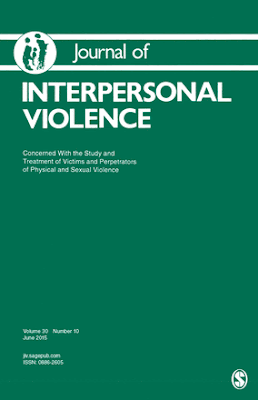
The Philosophy of Hate Crime: Special Section Edited by Myself And David Brax Published By The Journal of Interpersonal Violence


I have been posting a few times over the last couple of years about themes, events and media linked to my engagement in research on philosophical and ethical aspects of hate crimes, hate crime law, and policy relating to this. The engagement originates from my participation in the European Commission funded project When Law and Hate Collide, and I'm now happy to be able to announce the final publication of one of the main academic outputs of this project: A special section of the Journal of Interpersonal Violence on the theme of the philosophy of hate crime, guest-edited by David Brax (my main collaborator in the project) and myself:


http://jiv.sagepub.com/content/30/10.toc

The section features an unusually (for a philosophy publication) diverse collection of specialists, representing philosophy, ethics, law, sociology and criminology, writing on a wide selection of philosophical and ethical aspects of hate crimes and related policy. The table of content looks as follows:


http://jiv.sagepub.com/content/30/10.toc

David Brax's and my introduction, where the theme of the philosophy of hate crime, as well as the content of the individual contributions, are briefly explained, has been made "open access", that is freely available for reading or download by anyone. If you lack the access (through private subscription or your university library or other institutional link) to read the other contributions, please contact the individual authours to obtain copies of their respective articles!