




 Posts
Posts


Yea, what he said! These things are all outcomes of ongoing research in the cross-disciplinary project Organizing Person Centred Care in Pediatric Diabetes: Communication, Decision-making, Ethics and Health, where myself and some younger philosophers/ethicists collaborate with psychologists, linguists, care and organisation researchers and medical specialists. The project's original plan can be seen here. We are now a few years in and the last week has been a hectic one of delivery both at the yearly international conference of pediatric and adolescent diabetes specialists, ISPAD 2013, that was held in my town last week, and an ethics seminar at the University of Groningen that I visited this thursday.
Here's what came out:
1) An oral presentation (slides) of the main results so far of our entire project, delivered by one of the senior researchers, Marianne Törner.
2) A poster by my Ph.D. student Thomas Hartvigsson and myself, presenting results from an ongoing analysis of videotaped meetings between doctors, patients and parents on the possible value of assessing decision competence as part of a person centred consultation session. The title is Respecting the Adolescent Diabetes Patient as an Autonomous Person - What Does it Imply? Assessing and Managing Decision Capacity for Care Decisions and Self-care
3) Another poster, this time by my post doc in the project, Anders Herlitz, and myself likewise presenting results from an ongoing analysis of videotaped meetings between doctors, patients and parents, this time in the form of a general claim with regard to how person centred care and shared decision making needs to be adapted to fit patients with weak or vulnerable capacities for responsibility and conditions requiring care to be mostly self-managed. The title is The Moral Psychology of Person Centred Adolescent Diabetes Care: two potentially conflicting ethical dimensions of shared decision making for sustainable self-care
4) An oral presentation (slides) that I gave in Groningen more or less at the same time as Anders presented the one above that develops our argument that standard models of shared decision making and person centredness of care lacks a crucial virtue ethical elelment that needs to be added and that this complicates the ethical assessment of the organisation of such care. The title is the same as above.
Currently me and Anders and Thomas and the rest of the team are working hard on, first, two articles, that we hope to submit shortly, and then another batch of two following up more complications of person centred acre and shared decision making that we have discovered through our video-studies. Stay tuned!
Monday, 21 October 2013


Tuesday, 24 September 2013
Why Southern Sweden's Police Should Immediately Create a Registry of Police Officers and their Families
So here's the not so very tasty news from my country today, broken by our largest daily, Dagens Nyheter: The police force of southern Sweden has been running a registry, based on biological/genetic/familial/genealogical principles worthy of any classic nazi or racial biologist, of roma or "traveller" people, comprising of over 4000 persons, among which are 1000 plus children – and also some long deceased ancestors. Read English reports here, here and here (some other Swedish reports are here, here, here, here). One of the family-tree structures look like this (click it for more examples):

The police of south Sweden has made a number of increasingly pathetic attempts to dodge this obviously undodgeable shitstorm, ranging from first denying the existence of any registry, then admitting that but claiming that it is not organised by any "ethnic" principles (the title of the registry is "traveler abouts" – duh!), then possibly sensing this is not going to go away, starting to shift the blame to the classic sort of patsy: the lone, slightly crazed police officer acting "on his own" and excessing a little bit in his/her otherwise admirarable sense of duty. This nice composition of headlines from today sums up how totally feeble and cowardly this whole thing is being handled by those responsible locally:
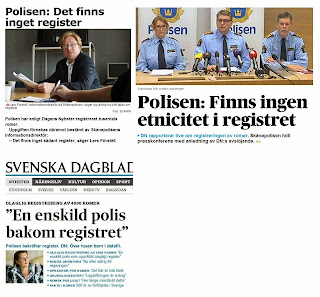
Right. And at the same time the registry, for legally it is one, is reported to have been in wide use, not only in the south, but also in my own quarters of Western Sweden, for instance. Ok, so maybe not a lone gunman after all....
By now the national chief of police, Bengt Svensson, reacted strongly and critically, to say the least, and ordered all regional chiefs to probe if anything similar is going on anywhere else (you hear those shredders working all through the nights, and all those hard-drives being dismounted and crushed, folks?) and, in consequence, the police has reported itself to.... the police and the relevant prosecutor has already said that an investigation will be opened regarding possible crimes against the law on registration of personal information (PUL, which is pretty strict), and possibly other laws as well. A bit late, but still, our minister of Justice, Beatrice Ask – otherwise famous for condoning police racial profiling, or at least pooh-poohing reports about it – also has made a statement. Should that fail, the Council of Europe's commissioner for human rights, Nils Muznieks, has already stated his view that the whole thing is in violation of the European Convention on Human Rights (since Sweden is an EU member state, also a part of my country's constitution), so that would take the case to a probable loss in the European Court of said human rights, which would then force a legal change, if necessary. In parallel, also today, UN's committee against racial discrimination is once again mounting criticism against Sweden, among other things for its lack of action against discrimination and stigmatisation of people of roma origin.
This leads into the funny bit, which motivates this post:
It is namely the last line of defense (offered by deputy chief, Petra Stenkula, and picked up by this shady excuse for a legal commentator, to mention one of a bunch – nice company you keep, deaputy chief!), apparently, of the south Sweden police, that the registry (which is not a registry, but a "list") of roma or travelers (which is not that but a list of "traveler abouts") is (at least initially), in fact a completely legitimate part of a police investigation of some crime connected to a family feud some years back – let alone, it might have gone a bit astray over the years. Right, that's why they need those long deceased people born in the 1800's and the two year olds in there - stupid me, I should have known!
But wait a bit, let's not be too harsh!! Let's in fact accept this explanation - it is actually quite apt by the police to set up registries of this sort, if only it pertains to an ongoing criminal investigation. Let's now chew really well on exactly that:
As we saw, there's a new criminal investigation that has just been opened! Apparently it's about police officers in south Sweden creating and using possibly illegal and unlawfully racist registries of people. So, let's accept the just given explanation and the principle that it implies and act really thoroughly on that: Let's have that registry of all those police officers in south Sweden who are potentially implicated for setting up or using (the Swedish law relevant here may actually ban mere use) the registry – quite possibly that'll be all of them. And be very sure to have deputy chief Stenkula's name as the very first entry, as the feeble attempt at whitewashing that she has offered obviously makes her a prime suspect. And while you're at it, let's put all their family members in there too - including small children of about two and up and a few long dead ones as well, just for good measure.
You just act on your own fine principles and do just that! Savor how good it feels! Do it tomorrow, do it now, do it yesterday and enjoy!
The police of south Sweden has made a number of increasingly pathetic attempts to dodge this obviously undodgeable shitstorm, ranging from first denying the existence of any registry, then admitting that but claiming that it is not organised by any "ethnic" principles (the title of the registry is "traveler abouts" – duh!), then possibly sensing this is not going to go away, starting to shift the blame to the classic sort of patsy: the lone, slightly crazed police officer acting "on his own" and excessing a little bit in his/her otherwise admirarable sense of duty. This nice composition of headlines from today sums up how totally feeble and cowardly this whole thing is being handled by those responsible locally:

Right. And at the same time the registry, for legally it is one, is reported to have been in wide use, not only in the south, but also in my own quarters of Western Sweden, for instance. Ok, so maybe not a lone gunman after all....
By now the national chief of police, Bengt Svensson, reacted strongly and critically, to say the least, and ordered all regional chiefs to probe if anything similar is going on anywhere else (you hear those shredders working all through the nights, and all those hard-drives being dismounted and crushed, folks?) and, in consequence, the police has reported itself to.... the police and the relevant prosecutor has already said that an investigation will be opened regarding possible crimes against the law on registration of personal information (PUL, which is pretty strict), and possibly other laws as well. A bit late, but still, our minister of Justice, Beatrice Ask – otherwise famous for condoning police racial profiling, or at least pooh-poohing reports about it – also has made a statement. Should that fail, the Council of Europe's commissioner for human rights, Nils Muznieks, has already stated his view that the whole thing is in violation of the European Convention on Human Rights (since Sweden is an EU member state, also a part of my country's constitution), so that would take the case to a probable loss in the European Court of said human rights, which would then force a legal change, if necessary. In parallel, also today, UN's committee against racial discrimination is once again mounting criticism against Sweden, among other things for its lack of action against discrimination and stigmatisation of people of roma origin.
This leads into the funny bit, which motivates this post:
It is namely the last line of defense (offered by deputy chief, Petra Stenkula, and picked up by this shady excuse for a legal commentator, to mention one of a bunch – nice company you keep, deaputy chief!), apparently, of the south Sweden police, that the registry (which is not a registry, but a "list") of roma or travelers (which is not that but a list of "traveler abouts") is (at least initially), in fact a completely legitimate part of a police investigation of some crime connected to a family feud some years back – let alone, it might have gone a bit astray over the years. Right, that's why they need those long deceased people born in the 1800's and the two year olds in there - stupid me, I should have known!
But wait a bit, let's not be too harsh!! Let's in fact accept this explanation - it is actually quite apt by the police to set up registries of this sort, if only it pertains to an ongoing criminal investigation. Let's now chew really well on exactly that:
As we saw, there's a new criminal investigation that has just been opened! Apparently it's about police officers in south Sweden creating and using possibly illegal and unlawfully racist registries of people. So, let's accept the just given explanation and the principle that it implies and act really thoroughly on that: Let's have that registry of all those police officers in south Sweden who are potentially implicated for setting up or using (the Swedish law relevant here may actually ban mere use) the registry – quite possibly that'll be all of them. And be very sure to have deputy chief Stenkula's name as the very first entry, as the feeble attempt at whitewashing that she has offered obviously makes her a prime suspect. And while you're at it, let's put all their family members in there too - including small children of about two and up and a few long dead ones as well, just for good measure.
You just act on your own fine principles and do just that! Savor how good it feels! Do it tomorrow, do it now, do it yesterday and enjoy!
Saturday, 21 September 2013
When is a Person's Religion A Personal Matter and When is it Not?
The following piece will not dig deep into the concept of religious belief and how it may or may not be different than other sorts of belief or committments. I have done that elsewhere.
I am happy to live in a country that is fairly secularised in the political sense. This secularisation is of the sensibly liberal and tolerant kind, where people of openly displayed, institutionalised religious affiliation are as welcome as anybody else to run for political office, and anyone that may feel like it has the right to make religiously grounded arguments to support or reject political suggestions. Of course, it is also free for all to publicly display whatever symbol of one's faith on one's body that one may please – just as free as it is for anybody to display any sort of symbol of any kind, as long as these are not of particular types of political meaning (due to hate speech considerations). At the same time, while there are quite a few people in Sweden that belong to or identify with institutionalised religious organisations, rather few take the specific content of their faith into the realm of politics or public debate, albeit this content may inspire their political opinions and influence, e.g., voting behavior. These people expect, quite reasonably so, to be left free by society and other people to practice their religion as they please within then the same legal framework that demarcates acceptable behavior for any sort of personal or life-style activity. True, other people may have opinions about this and are free to express those, just as they may have opinions on any sort of activity of other people, but that's nothing special for institutionalised religion. In cases like this, which are the most common in my own country, people's religion are undoubtedly a purely personal matter, just as one choice of favourite sports team is.
Fine. But what about when a person of such religious commitment takes it with him or her into a political career, in particular when such a person belongs to a religious institution that openly propagate particular and strong political views, say, with regard to the legislation around abortion or people of LGBTQ sexuality. This is a heated issue at the moment in my country, as our prime minister, who represents a party (Moderaterna) presenting itself mainly as a liberal or even (when it comes to taxes, public services and trade) libertarian political body – although in the now rather distant past, it used to stand for a more traditional value conservative stance (King and Country and Church and the glorious days of old and so on) – choose to include in his newly formed cabinet a minister of just this sort of religious affiliation, Elisabeth Svantesson. The choice sparked immediate controversy (here, here), as Svantesson used to belong to an extreme neo-calvinist, Christian right, militant pro-life church, called Livets Ord, has been markedly active in the organised movement against current Swedish abortion legislation, and now belongs to a church called Kristet Centrum, that is not only openly oppose that legislation, but also openly stands for very negative views of LGBTQ people and seems to propagate a rather restrictive room for them to entertain the same rights in the area of family as others (Swedish links: here, here, here, here, here). A young, female representative of Moderaterna has publicly demanded that Svantesson officially distance herself from the political movements against legal abortion etc., or at least clarify where she stands. Svantesson herself has tried to rebut such requests as being about a "private matter", and she has been defended against the criticism by a number of debaters claiming that the critique is an example of persecution – the word "witch-hunt" has even been used – due to her religious faith, albeit one analyst has made the point that she is probably being let off the critical hook more easily than if she had been a muslim and had had a history of fundamentalist views coming from that particular camp.
My own view is the following. When a religious organisation propagates particular political views as part of its religious message, the question of whether or not a person of political office belongs to or sympathises with that institution or its message is certainly not a private or personal matter anymore. This is so, because such a religious institution is just as much a political organisation – the one does simply not exclude the other. The fact that such a political organisation also has a religious side to it cannot and should not immunise it against public critical scrutiny of the political views it represents, and the same goes for its political representatives. In this case, Elisabeth Svantesson.
The remaining issue is, of course, how sound the criticism is. With the extremely solid public support of the Swedish liberal abortion legislation (a pregnant woman a a positive right to have an abortion performed up to pregnancy week 18, after that it is very very difficult to have one and special permission is needed, but out of the question if the fetus is viable), the possible smuggling into the highest circles of political power a person committed to the opposite view would seem pretty relevant for voters. Similarly, a predominantly liberal/libertarian party lika Moderaterna, would seem to have a qualified identity problem if one of its highest political officers and most influential members represent ideas in the area of sexual orientation and identity related rights that sparks such a stark contrast to the party mainstream as reports suggest. True, with about a year to the next parliamentary elections, this is mostly a tactical problem for Moderaterna, but my point is simply that the fact that the problem has its roots in a minister's religious fundamentalist convictions does nothing to make it go away, in fact or even ideally. In conclusion, Svantesson needs to come clean and cannot hide behind a shield of alleged privacy or immunity against criticism for religion-based political ideas.
I am happy to live in a country that is fairly secularised in the political sense. This secularisation is of the sensibly liberal and tolerant kind, where people of openly displayed, institutionalised religious affiliation are as welcome as anybody else to run for political office, and anyone that may feel like it has the right to make religiously grounded arguments to support or reject political suggestions. Of course, it is also free for all to publicly display whatever symbol of one's faith on one's body that one may please – just as free as it is for anybody to display any sort of symbol of any kind, as long as these are not of particular types of political meaning (due to hate speech considerations). At the same time, while there are quite a few people in Sweden that belong to or identify with institutionalised religious organisations, rather few take the specific content of their faith into the realm of politics or public debate, albeit this content may inspire their political opinions and influence, e.g., voting behavior. These people expect, quite reasonably so, to be left free by society and other people to practice their religion as they please within then the same legal framework that demarcates acceptable behavior for any sort of personal or life-style activity. True, other people may have opinions about this and are free to express those, just as they may have opinions on any sort of activity of other people, but that's nothing special for institutionalised religion. In cases like this, which are the most common in my own country, people's religion are undoubtedly a purely personal matter, just as one choice of favourite sports team is.
Fine. But what about when a person of such religious commitment takes it with him or her into a political career, in particular when such a person belongs to a religious institution that openly propagate particular and strong political views, say, with regard to the legislation around abortion or people of LGBTQ sexuality. This is a heated issue at the moment in my country, as our prime minister, who represents a party (Moderaterna) presenting itself mainly as a liberal or even (when it comes to taxes, public services and trade) libertarian political body – although in the now rather distant past, it used to stand for a more traditional value conservative stance (King and Country and Church and the glorious days of old and so on) – choose to include in his newly formed cabinet a minister of just this sort of religious affiliation, Elisabeth Svantesson. The choice sparked immediate controversy (here, here), as Svantesson used to belong to an extreme neo-calvinist, Christian right, militant pro-life church, called Livets Ord, has been markedly active in the organised movement against current Swedish abortion legislation, and now belongs to a church called Kristet Centrum, that is not only openly oppose that legislation, but also openly stands for very negative views of LGBTQ people and seems to propagate a rather restrictive room for them to entertain the same rights in the area of family as others (Swedish links: here, here, here, here, here). A young, female representative of Moderaterna has publicly demanded that Svantesson officially distance herself from the political movements against legal abortion etc., or at least clarify where she stands. Svantesson herself has tried to rebut such requests as being about a "private matter", and she has been defended against the criticism by a number of debaters claiming that the critique is an example of persecution – the word "witch-hunt" has even been used – due to her religious faith, albeit one analyst has made the point that she is probably being let off the critical hook more easily than if she had been a muslim and had had a history of fundamentalist views coming from that particular camp.
My own view is the following. When a religious organisation propagates particular political views as part of its religious message, the question of whether or not a person of political office belongs to or sympathises with that institution or its message is certainly not a private or personal matter anymore. This is so, because such a religious institution is just as much a political organisation – the one does simply not exclude the other. The fact that such a political organisation also has a religious side to it cannot and should not immunise it against public critical scrutiny of the political views it represents, and the same goes for its political representatives. In this case, Elisabeth Svantesson.
The remaining issue is, of course, how sound the criticism is. With the extremely solid public support of the Swedish liberal abortion legislation (a pregnant woman a a positive right to have an abortion performed up to pregnancy week 18, after that it is very very difficult to have one and special permission is needed, but out of the question if the fetus is viable), the possible smuggling into the highest circles of political power a person committed to the opposite view would seem pretty relevant for voters. Similarly, a predominantly liberal/libertarian party lika Moderaterna, would seem to have a qualified identity problem if one of its highest political officers and most influential members represent ideas in the area of sexual orientation and identity related rights that sparks such a stark contrast to the party mainstream as reports suggest. True, with about a year to the next parliamentary elections, this is mostly a tactical problem for Moderaterna, but my point is simply that the fact that the problem has its roots in a minister's religious fundamentalist convictions does nothing to make it go away, in fact or even ideally. In conclusion, Svantesson needs to come clean and cannot hide behind a shield of alleged privacy or immunity against criticism for religion-based political ideas.
Subscribe to:
Posts (Atom)