
Showing posts with label Derek Parfit. Show all posts

Thursday, 5 January 2017

Remembering Derek Parfit


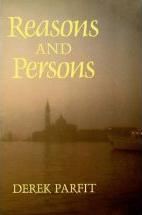
Unexpectedly, Derek Parfit died on new year's day 2017, an event sending shock-waves throughout the global philosophy community, as he was no more than 74 years old. For you who don't know who he was, it can be summed up in terms of the most important moral philosopher of the 20th and, so far, the 21th century. With his book Reasons and Persons (Oxford UP, 1984), he single-handedly redrew the intellectual maps of normative ethics, philosophy of action and rationality, value theory and existential philosophy, partly by making intriguing revelations of how they interconnect, and demonstrating puzzles and challenges coming out of that, which a lion's share of the philosophy world is still grappling with in one way or the other. He followed that up with the monumental On What Matters, of which two volumes have been published and a third is rumoured to be on its way later this year. In 2014 Parfit was awarded the Rolf Schock Prize in Logic and Philosophy, which I celebrated with this little parody piece of his distinctive writing style.

There's already a fair portion of good in memoriam pieces out there, featuring personal reminiscence, summaries of his life and works, as well as links to videos of his lectures. A nice listing can be found on Harvard University's (one of the top institutions to which Parfit was linked) memorial webpage.

I never had the pleasure of meeting Derek Parfit in person (and many bear witness of that this would indeed have been a pleasure), but his philosophical work has had a large impact on my own philosophical explorations, for what they're worth. When I started to attend the "higher seminar" in practical philosophy at Stockholm University in 1985, Reasons and Persons was on the reading list for a full term, and the seniors took turns introducing the different parts, sucking me and the other "youngsters" into sophisticated philosophical reasoning and argument on a level way above what we had ever experienced before. I choose, as a consequence, to write my B.A. thesis on a few pages of part 2 of the book, where Parfit defends what he calls the "Critical present aim theory" of practical reason or rational action, according to which certain individual desires may be irrational in themselves due to their very content. I was critical of Parfit's way of supporting "CP", as I found it putting the cart before the horse by invoking what to me looked like a fundamental moral conviction (that it's not justified to prefer suffering just because it occurs on certain weekdays) as its basis, which would be problematic in a question begging manner given Parfit's aim of using CP to support the idea of objective moral truths. But this was more importantly a formative experience of how well made philosophy will always be open to questioning if only you work hard enough on understanding its details – gaps for criticism are only absent when the work is marked by obscurity and ambiguity, and therefore you should never fear obvious openings for disagreement in your own work, they are unavoidable. Later, I wrote my Ph.D. thesis on the morality of abortion (in Swedish), and there both the discussion of personal identity over time, and (more importantly) the moral importance of future people came to provide very important input. These aspects of his work then continued to have an impact of my later work in bioethics, e.g., on embryo research, reproductive ethics and gene technology. Later, Parfit's musings over problems of collective action, value aggregation and the pragmatics of applying ethical theories in practice (part 1 of Reasons and Persons) added important context and basis for my contributions to public health ethics and the ethics of risk and precaution.

Now, it should be underlined, that Parfit's influence has never been that of a prophet – someone's whose teachings one accepts and then spends one's life as a follower of, working out the details with the assumption that the master's words must never be doubted. Parfit's strength was never the thesis, but the argument and its analysis – often leading to initially apparently clear positions falling apart into zillion variants, each of which in need of their own little set of arguments. When he pursued a substantive thesis, I often disagreed with him, albeit acknowledging much of the analytical landscape created to reach it. Parfit was a philosopher who ingeniously created intellectual context and complication for others to freely move about within. In that way, much of whatever I have ever managed to contribute to my own little corners of the vast world of philosophy wouldn't have been there for the picking, had it not been for the context of problematisation and complexity provided through Parfit's prior achievements. This, I'm convinced, is true of a great many other currently active philosophers as well. And I believe that this will continue to be the case for a fair amount of time ahead.

***


Friday, 14 February 2014

What is Derek Parfit to do with the Prize Money? Preliminary Explorations

As I reported yesterday, All Souls (Oxford) emeritus and moral philosophy giant Derek Parfit has been selected as the 2014 Rolf Schock Logic and Philosophy laureate and, in effect, will receive about € 68 000. After having cheered at this excellent choice for about 24 hours (this affirming him as a worthy winner), I'm now moving to the next, obviously more pressing question:

Whatever should he do with the money??

There are, to start with, three crude options – a sort of A, B, C of the philosophy of Derek Parfit, if you want – needed scrutiny to commence exploring this complex issue, which has received far too little attention since Sartre refused the Nobel Prize, before getting philosophically serious with some deeper complications. I will here preliminary probe this exciting topic, employing only some of the tools sharpened and left ready for use on the kitchen zinc by the master himself.

Thus:

Consider:

The three options:

The Grand Gesture
Derek refuses the money in a grand gesture of public display - e.g., as a protest against the lack of female Schock laureates, the ridiculousness of scientific prizes, or somesuch.

Well-earned Enjoyment During the Fall of Life
Derek receives the money and then spends it on having a good time for himself and his close ones after a long life of hard academic work and duty.

Making the World a Better Place
Derek receives the money and uses it for a morally good cause (better than giving them away to elderly philosophy professors, that is).

Some philosophers would doubt that any of these strategies can be justified. I claim, however:

The Parfit As the Assumed Subject – Holding Certain Positions which Will Not Change Just Because Someone or Else Doubts them – of this Blog Post Justificatory Principle Claim:
 A blog post discussing a subject related to Derek Parfit which is not literally about the issue of the possibility of justifying normative positions, can assume the Parfit stance on the possibility of justifying normative positions.

That is, that it exists. A little bit, I'm sure. In principle, at least. And being in the land of principles at the moment, this will do until I'm done (see the latter part of this post).

However, affirming (tentatively) this possibility does not imply that it is easy. On the contrary, I claim:

The Very Much Difficulty of Solving Intricate Moral Problems Related to Derek Parfit Claim

Which, I trust, explains itself (and, if you insist, can be confirmed by at least 15 years of Swedish practical philosophy students at the BA level).

Now, consider the option of The Grand Gesture. It is obvious from his writings that Parfit is enough of a consequentialist to hold this option as justified only if it leads to some sort of sufficiently good relevant effect, such as a future adjustment of the gender imbalance of the prize laureates or the refusal of the Rolf Schock Foundation to award any more prizes. However, it is equally obvious that any such effect depends on not only what Derek Parfit does, but how this is fitted in with what a large number of other agents do (and in this case, have done). Therefore:

Consider:

The Possibly Endlessly Divided Possible Protest
Many people, some now, some in the past and some, yet unidentified, in the future may together act to form an effective and justified protest for the worthy cause C. However, some in the past have already failed to do their part and it is undecided how many in the future will, although we assume that it is possible for enough of the latter (whose total number is unknown) to act in a such a way as to make a choice of the presently deliberating agent Derek to participate in the possible protest into actually participating in an actual effective protest which will eventually be completed.

What should Derek do?

This is a conundrum demanding theory X, and thus we presently lack the theoretical context to properly assess The Grand Gesture and I for one will dub any attempt at doing it in the absence of X as the 6th mistake in moral mathematics.

Therefore, instead consider the option Well-earned Enjoyment During the Fall of Life. It is obvious that any worse wise-cracker than me would here begin invoking puns relating to problems of personal identity and thereby believe something of relevance to the philosophy of Derek Parfit having thus been linked to a ridiculous attempt at being funny at the expense of his obvious aging. I reject this claim. Instead, I affirm the claim that relation R is what creates trouble for the Well-earned Enjoyment During the Fall of Life. While it is patently obvious that the Derek receiving the prize is also the Derek who deserves it whatever his ages at different stages might have been, and thus the right to enjoy it – he has the same social security number as that young man winning an All Souls fellowship without having a doctorate and who eventually went on writing an influential little essay called "On doing the best for our children", doesn't he?! Duh! – so, that's obviously settled as a deepest of deep further facts. However, lacking enough of relation R – I mean, just look at that hair!....


....and no glasses as in some other and earlier pictures I have seen – this is of no help, as relation R is what matters.*

Thus pending theory Y, which would provide the missing reason for why a laureate should enjoy a prize in the absence of relation R, it is time to move on to the option Making the World a Better Place. 

Consider:

(Q) Quirky as it may be to determine what is a morally good cause in the case of Derek, there actually exists one.

(P) The good cause referred to in (Q) is (as it were!) (N)**

Even if that is so, however, it may be undetermined what N is. Many would claim the opposite (and truth to be told, so would I if I had only eaten a better lunch), but I nevertheless claim that although N does exist, there is no definite N, such that Derek should choose promote that particular N with his (well-earned) prize-money. In effect, there is no reason for Derek to choose option Making the World a Better Place.

Oh, well, Nagel might object, so:

Consider:

The Many Equally Important Beneficiaries of Derek's Doing Good
Depending on exactly how Derek goes about doing good with his prize money by choosing a particular version of N, different people will travel around differently, meeting different people and so on, after 5000 years resulting in a great number of different spermatozoa to exist than if Derek had made another choice of N. Perhaps all of the ova will be the same, how would I know? But the central fact we assume is this: the good of Derek's action for the world will not occur earlier than in 5000 years time. Thus completely different people will benefit and let us – when we're at it, what the heck – assume that they would all benefit the same. Some economists would question that claim. I, however, claim the opposite of that questioning, thus affirming my original claim as positively supported from a theory of rationality yet to be formulated.

In any case, the upshot is that we need theory – obviously!! – Z to be able to provide a reason for picking out any particular way of doing N in order be justified in any sort of rational support of Making the World a Better Place. We are back were we started in our Derek Parfit A, B, C:

X, Y, Z.

Ta! from Gothenburg!

*) Some readers may not remember the famous relation R from the now lost 34th edition postscript to Reasons and Persons, where the overly abstract notion of the original analysis of R had been ironed out to more concrete form; now signifying the As Ravingly Dashing Head of Hair as Ever relation.
**) If you ask yourself what (N) is, you obviously know nothing of philosophy and needs to attend university.


Thursday, 13 February 2014

Derek Parfit Wins the 2014 Royal Swedish Academy of Science Rolf Schock Prize in Logic and Philosophy


I'm happy to announce that this year's Rolf Schock prize in philosophy and logic has been awarded to University of Oxford All Souls College emeritus fellow Derek Parfit. The prize, which also is awarded in mathematics and the musical and visual arts is of a sizeable sum of 600 000 Swedish krona ≈ € 68 000 ≈ $ 93 000 and is one of, if not the, largest research prizes in philosophy. Former laureates include W.V.O. Quine, John Rawls, Hilary Putnam, Thomas Nagel, Saul Kripke and some other monumental names of 20th and 21th century Western academic and, let's be fair, anglophone philosophy. The list still waits to include a female receiver, I'm sorry to say.


But this takes nothing away from Derek Parfit, who has single-handedly transformed contemporary systematic moral philosophy more than anyone after John Rawls. Already his 1984 modern classic Reasons and Persons earned him the motivation of the selection committee that he receives the prize “for his ground-breaking contributions concerning personal identity, regard for future generations and analysis of the structure of moral theories”. This is a book that no even semi-serious scholar of ethics can avoid, as Parfit picks apart established ethical traditions and theories in to their bare bones, and further on into their marrow, to finally come out on the other side with a completely new research program for academic ethics scholars and moral philosophers, regarding, for instance, how to think about part-whole conflicts, personal identity and demarcation, future generations and population policy, the structure and role of theories of the good life, and the relationship between practical rationality, morality and the normativity of moral deliberation. He works in the very best of the British academic philosophical tradition, where Hume and Sidgwick are two of the most obvious influences, and has a now well-known style of writing that, as in the case of Quine, is imitated by many but mastered by only one. A few years back, he published the more synthetic and rather monumental work On What Matters, but to me R and P is what makes Parfit the giant he is, as his refusal of being content with any of the suggestions he contemplates there and the constant unfolding of new layers of paradox of human moral thought has produced fuel for philosophers to work on for, I'd say, at least a few centuries ahead.

On of Parfit's exceptional qualities is his straightforward and simple way of moving effortlessly from highly technical exercises of intricate problems into the most engaging narrative examples, broadly fleshed out to provide humanity to the philosophical issues he engages with. This excerpt from Reasons and Persons, where the theme of personal identity is introduced is a well-known example:


When I started to get serious about philosophy and together with a friend, while still studying on the undergrad level, was invited to attend the "higher seminar" of practical philosophy in Stockholm, Reasons and Persons had just come out and was the topic for a term's discussions, and it was refreshing to watch how all of the seniors around were as shaken by the radical and far-reaching challenges presented by that book as I was. A term later, I wrote my B.A. thesis on 25 pages in the beginning of the book, where Parfit defends a theory of practical rationality that allows for "intrinsically irrational desires" (such as preferring suffering on tuesdays, while otherwise disliking suffering as much as any other one). I was critical of that theory, as I have been of much other of Parfit's own philosophical claims over the years, for instance in my extensive use of his seminal analysis of the morality of creating and influencing future people taking place in part four of the book for the purpose of explicating a consequentialist theory of the morality of abortion in my Ph.D. thesis. But the great thing about Parfit, is that he is not the sort of philosopher whose value is found in him "being right" (or, as is usually the case with such specimen – wrong) – it's rather the way in which he is often able to demonstrate that most of the things we have been taken for granted as obvious or unproblematic must, in fact, be rejected and new, hitherto unknown, answers must be sought out in a project forcing us to rethink just about everything.

Congrats!